How is AI used in compliance monitoring?
AI compliance monitoring uses machine learning and policy automation to continuously validate that AI systems operate within defined regulatory and organizational boundaries. Instead of periodic manual reviews, AI-powered compliance monitoring inspects every model inference, agent action, and data access in real time, checking permissions, evaluating outputs against policy rules, and generating audit evidence automatically. For eCommerce, this means your recommendation algorithms, dynamic pricing engines, and other AI systems are validated for GDPR data processing compliance, pricing fairness standards, and customer privacy requirements at the moment of execution, not days later in a compliance review.
What is AI compliance monitoring?
AI compliance monitoring is the continuous, automated oversight of AI systems to ensure they adhere to regulatory requirements, organizational policies, and ethical standards throughout their operational lifecycle. It goes beyond traditional software compliance by addressing the unique challenges of AI: dynamic decision-making, probabilistic outputs, data lineage tracking, and explainability requirements. Modern AI compliance monitoring operates at runtime, intercepting AI requests before execution to validate policy adherence, enforce guardrails on model behavior, prevent unauthorized data access, and maintain complete audit trails, all while maintaining the performance and responsiveness that eCommerce operations demand.
What types of eCommerce AI systems can Trussed AI monitor for compliance?
Trussed AI provides compliance monitoring across your entire eCommerce AI ecosystem: product recommendation engines and personalization systems, dynamic pricing and promotion algorithms, fraud detection and risk assessment models, inventory optimization and demand forecasting systems, and autonomous agents handling order management or returns processing. Our platform integrates as a proxy layer, providing unified governance regardless of whether you're using proprietary models, third-party APIs like OpenAI, or custom-trained systems deployed on AWS, Google Cloud, or Azure infrastructure.
How quickly can AI compliance monitoring be implemented in an existing eCommerce platform?
Trussed AI's drop-in proxy architecture enables compliance monitoring deployment in as little as four weeks from engagement to operational workflows. The implementation process involves no changes to your existing application code. Our platform sits between your eCommerce applications and AI models, intercepting requests to enforce governance in real time. For enterprises with complex multi-region deployments, legacy systems, or custom integrations, our AI Governance Advisory capability designs the governance framework and deployment strategy, typically delivering a proof of concept within the first two weeks and production-ready governance within 4-6 weeks depending on organizational complexity.
What compliance frameworks does the platform support for eCommerce businesses?
Trussed AI supports comprehensive compliance across regulations critical to eCommerce operations: GDPR for customer data protection and automated decision-making (Article 22), CCPA and state-level privacy laws for consumer data rights, PCI DSS for payment processing systems integrated with AI, FTC guidelines on algorithmic pricing and advertising, and sector-specific regulations like HIPAA for health-related products. Our regulatory mapping capabilities continuously align your AI governance policies with evolving requirements across multiple jurisdictions, automatically updating enforcement rules as regulations change.
How does runtime governance work without impacting eCommerce site performance?
Trussed AI's control plane is engineered for sub-20ms latency, ensuring compliance validation adds negligible overhead to customer-facing AI interactions. The platform operates as an intelligent proxy that evaluates policy compliance in parallel with AI processing, checking data access permissions, validating output against content guardrails, and logging audit evidence, without blocking the request path. For high-traffic eCommerce scenarios like peak shopping periods, our intelligent routing and failover capabilities maintain enterprise SLAs by automatically distributing load across model providers and scaling governance capacity elastically to match demand without sacrificing compliance coverage.
What kind of audit evidence does AI compliance monitoring generate for regulators?
Every AI interaction monitored by Trussed AI generates structured, audit-ready evidence including complete request and response traces with timestamps, policy evaluation results showing which rules were checked and their outcomes, model version and provider information for reproducibility, data lineage tracking showing what customer information was accessed, user and application context for access control verification, and cost attribution for financial accountability. This evidence is automatically organized to support GDPR Article 30 records of processing activities, internal audit requirements, external compliance examinations, and regulatory inquiries, eliminating the need to reconstruct AI decision history after incidents or during audits.
Can the platform prevent specific types of AI failures relevant to eCommerce, like biased pricing or inappropriate recommendations?
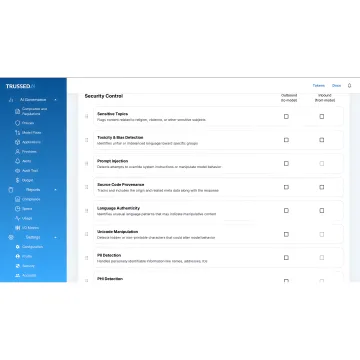
Yes. Trussed AI's governance engine enforces guardrails that prevent specific failure modes before they reach customers: pricing fairness rules that flag discriminatory patterns across customer segments, content filtering that blocks inappropriate product recommendations, PII protection that prevents customer data leakage in AI-generated responses, output validation that ensures promotional content complies with advertising standards, and budget controls that prevent runaway costs from inefficient model usage. These guardrails are evaluated in real time at the point of AI execution. If a recommendation engine attempts to generate biased results or a pricing algorithm violates fairness policies, the request is blocked and logged before any customer-facing impact occurs.