Introduction
AI governance has become a hard budget requirement. According to a Ponemon Institute study, the average cost of non-compliance,penalties, business disruption, and revenue loss combined,reached $14.8 million, roughly 2.7 times higher than the cost of maintaining compliance measures. Frameworks like the EU AI Act, NIST AI RMF, and HIPAA are driving that pressure directly into procurement decisions.
Pricing for enterprise AI compliance software is highly inconsistent. Costs shift based on the scope of AI systems governed, risk level, deployment model, and operational scale , leaving many buyers to either underbudget significantly or pay for capabilities they don't need.
The gap between spending and governance is real: while 87% of companies are increasing AI budgets, only 14% have established clear C-level governance, contributing to 48% of AI projects missing their business targets.
This guide breaks down realistic price ranges, the components that drive cost, what separates low-cost from high-cost solutions, and how to budget accurately for your organization's needs.
Key Takeaways
- Enterprise AI compliance software runs $20,000–$1M+ per year depending on scale, risk level, and framework complexity
- Key cost drivers: number of AI systems governed, regulatory frameworks in scope, deployment complexity, and build-vs-buy decision
- Limited regulatory exposure? Budget toward the lower end. Healthcare, financial Solution, or agentic AI deployments should plan for the higher end
- Scaling governance spend makes sense when non-compliance risk is high, manual oversight is burning engineering hours, or audit deadlines are tight
How Much Does Enterprise AI Compliance Software Cost?
Enterprise AI compliance software does not have a fixed price. Costs depend on the scope of AI systems being governed, risk tier, regulatory exposure, and deployment model , SaaS, on-premises, or hybrid.
Misunderstanding this leads to underbudgeting for implementation, choosing tools that can't scale with AI complexity, or overpaying for compliance overhead that simpler processes could handle.
Typical Price Ranges
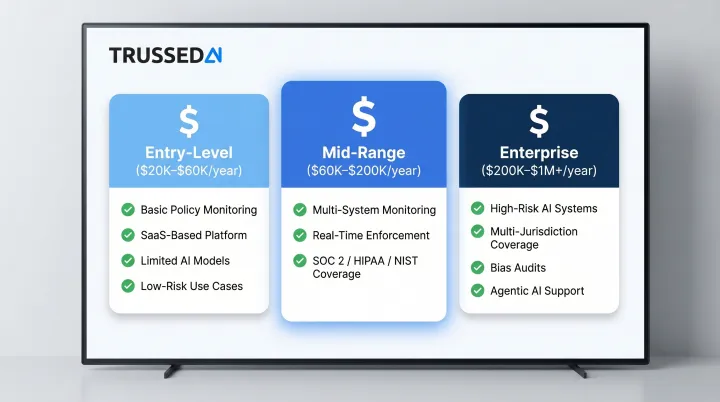
Entry-level ($20,000–$60,000/year):
- Basic AI policy monitoring, logging, and audit trail generation
- SaaS-based, with per-seat or per-model pricing
- Supports a limited number of models or applications
- Suited for low-risk AI applications, narrow regulatory scope, or early-stage governance programs
Mid-range ($60,000–$200,000/year):
- Comprehensive compliance monitoring across multiple AI systems
- Real-time policy enforcement
- Automated evidence collection for frameworks such as HIPAA and NIST AI RMF
- A strong fit for mid-size enterprises in regulated industries running multiple AI applications in production
Enterprise/High-Risk ($200,000–$1M+/year):
- Designed for high-risk AI systems , credit decisioning, clinical AI, autonomous agents
- Multi-jurisdiction regulatory coverage with continuous monitoring infrastructure
- Includes bias audits, human-in-the-loop workflows, and dedicated compliance engineering
- Built for large enterprises with complex AI portfolios or agentic AI in regulated environments
Most vendor quotes cover a defined set of capabilities , and leave others out. Here's what to check before signing:
| What's Usually Included | What's Usually Excluded |
|---|---|
| Software licensing | Custom compliance framework mapping |
| Standard integrations | Advanced integration with legacy systems |
| Monitoring dashboards | Third-party audit fees |
| Basic support | Dedicated compliance engineering staff |
Key Factors That Affect the Cost of Enterprise AI Compliance Software
AI compliance software pricing is shaped by a combination of technical, regulatory, and operational variables,understanding each factor helps avoid surprise costs and right-size the investment.
Risk Level and Type of AI Systems Being Governed
AI compliance costs scale sharply with system risk. Governing a customer-facing chatbot costs a fraction of governing an AI model making credit, hiring, or clinical decisions. High-risk systems require bias audits, explainability mechanisms, human-in-the-loop workflows, and more rigorous documentation,all of which drive costs up considerably.
The European Commission estimated that certification for an AI system under the EU AI Act could cost an average of €16,800–€23,000, roughly 10–14% of development cost. Industry estimates suggest compliance requirements add 10%–25% in extra cost per AI model in regulated sectors.
Beyond high-risk models, agentic AI and multi-model pipelines introduce further complexity. Autonomous agents require runtime policy enforcement,not just periodic audits,which demands more sophisticated tooling. Multi-agent compliance programs can easily cost $1M–$5M.
Regulatory Scope and Number of Frameworks
The more regulatory frameworks in scope, the higher the compliance overhead. Each framework requires tailored controls, documentation, and evidence,vendors charge more for multi-framework coverage. Common frameworks that compound costs include:
- EU AI Act and NIST AI RMF (risk classification and documentation requirements)
- HIPAA (data handling and audit controls)
- GDPR and state-level AI laws (privacy and automated decision-making rules)
Organizations operating across multiple jurisdictions face compounding costs as each location adds its own layer of jurisdiction-specific requirements.
Deployment Model and Integration Complexity
SaaS-based compliance platforms carry lower upfront costs but may have higher recurring fees at scale. On-premises or BYOC deployments have higher setup costs but give enterprises more control.
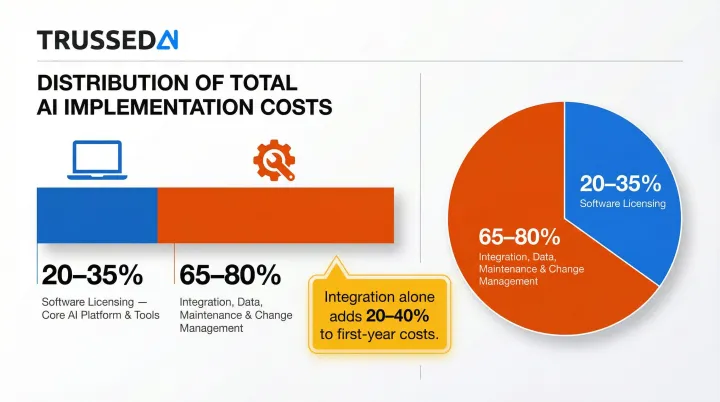
Integration complexity with existing AI infrastructure,model providers, MLOps platforms, developer tooling, legacy systems,is one of the most underestimated cost variables. Research from Gartner indicates that software costs represent only 20–35% of total AI implementation expenses; the remaining 65–80% covers data preparation, system integration, change management, and ongoing maintenance. Expect integration work to add 20–40% to first-year costs.
Platforms with drop-in proxy architecture can compress this timeline considerably. For example, Trussed AI requires zero application code changes and can achieve operational workflows in approximately four weeks, reducing integration engineering costs.
Scale of AI Operations
Pricing in many platforms is tied to usage metrics: number of models monitored, API call volume, number of AI applications, or number of users. Organizations with large-scale or fast-growing AI deployments on usage-based pricing can see costs spike quickly. Fixed-rate enterprise pricing is often more predictable for organizations running high AI workload volumes.
Build vs. Buy vs. Control Plane
Organizations choosing to build AI governance in-house face substantial costs in year one, including:
- Compliance engineering talent (median salaries reach $221,000 for technical AI governance roles in the tech sector)
- Infrastructure for logging, monitoring, and audit trail storage
- Ongoing regulatory update tracking and policy maintenance
These expenses routinely total $200K–$500K+ before any tooling costs.
Purpose-built compliance platforms reduce this overhead but require upfront implementation investment. A unified AI control plane goes further,enforcing governance at runtime across all AI systems from a single layer, which eliminates redundant tooling spend across siloed teams.
Full Cost Breakdown of Enterprise AI Compliance Software
The total cost of ownership extends well beyond the software subscription or license fee. Organizations that plan only for licensing face budget overruns when implementation, integration, and ongoing operational costs hit.
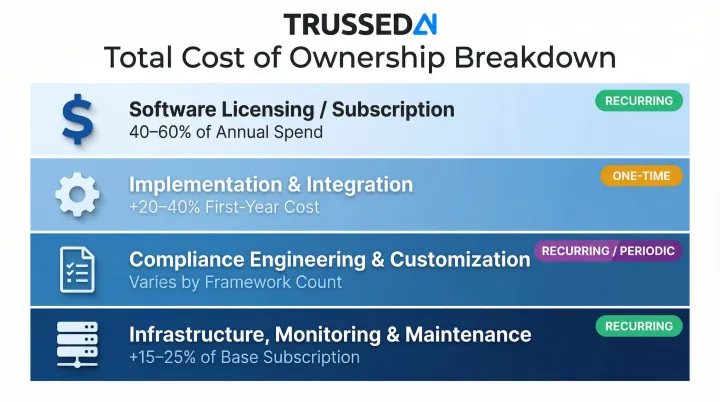
Here's how the four main cost categories typically break down:
| Cost Category | Type | Typical Share of Total Cost |
|---|---|---|
| Software Licensing / Subscription | Recurring | 40–60% of annual spend |
| Implementation & Integration | One-Time | +20–40% of first-year cost |
| Compliance Engineering & Customization | Recurring/Periodic | Varies by framework count |
| Infrastructure, Monitoring & Maintenance | Recurring | +15–25% of base subscription |
Software Licensing / Subscription The base platform fee, typically the quoted price from vendors. Pricing structures range from per-seat and per-model to usage-based and flat enterprise licensing. This is usually 40–60% of total annual cost once all other components are factored in.
Implementation and Integration Covers connecting the compliance platform to existing AI infrastructure, model providers, data pipelines, and enterprise systems. This includes API development, data migration, custom policy configuration, and testing. Industry research suggests implementation typically adds 20–40% to the first-year investment.
Platforms with drop-in proxy architecture , Trussed AI requires zero application code changes , can cut this timeline to roughly four weeks and reduce integration engineering costs substantially.
Compliance Engineering and Ongoing Customization Covers mapping controls to specific regulatory frameworks, updating policies as regulations evolve, maintaining bias auditing processes, and customizing reporting for audit requirements. For multi-framework environments, this is a meaningful ongoing expense.
Manual evidence assembly for audits often consumes 200+ hours of legal team time per audit cycle, diverting resources and creating risks of incomplete documentation.
Infrastructure, Monitoring, and Maintenance Covers compute, storage, and logging infrastructure required to support continuous compliance monitoring. For high-volume AI environments, this includes storing audit logs, maintaining monitoring dashboards, and running real-time policy enforcement. Annual maintenance and system upkeep typically adds 15–25% on top of base subscription costs.
Low-Cost vs. High-Cost Enterprise AI Compliance Software , What's the Difference?
Not all enterprise AI compliance tools are built for the same problem. Budget solutions handle documentation and basic monitoring. Premium solutions enforce governance at runtime, across dynamic AI systems, with continuous evidence generation.
The price gap reflects a capability gap , and that gap becomes a liability the moment a regulator asks for evidence you can't produce.
Performance and Coverage
[Section content missing , body of "Performance and Coverage" H3 and all subsequent content requires restoration before publication.]