Introduction
Most enterprises are spending heavily on AI while underinvesting in the governance required to run it safely. A 2025 survey found that 72% of enterprises expect increased LLM spending, yet only 25% have fully implemented AI governance programs.
That gap has a price tag. According to EY research, 99% of organizations report financial losses from AI-related risks, and 64% have suffered losses exceeding $1 million.
This article breaks down what enterprise AI governance actually costs: staffing, tooling, compliance frameworks, and ongoing operations, across small, mid-size, and large enterprise deployments, so you can budget for it with confidence.
Key Takeaways
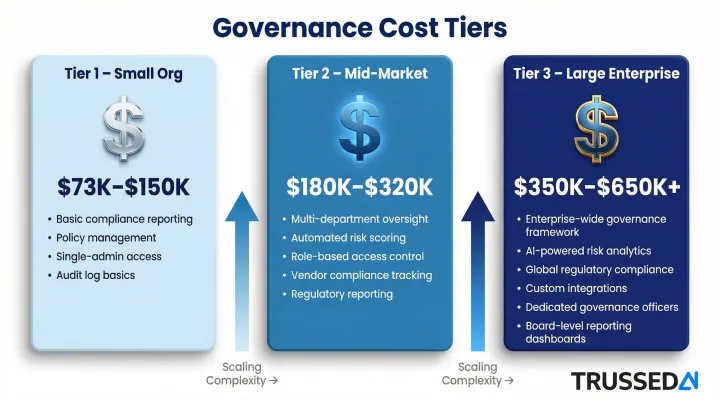
- Enterprise AI governance costs range from $73,000–$150,000 annually for small organizations to $350,000–$650,000+ for large enterprises, driven primarily by deployment complexity and regulatory obligations
- Key cost drivers: number of AI systems governed, regulatory environment, staffing model, and manual vs. automated tooling
- Manual governance has a hidden scaling problem , each new AI system added drives costs proportionally higher, fast
- Budget for governance based on your actual risk profile, deployment footprint, and compliance obligations , not the lowest number that fits
How Much Does Enterprise AI Governance Cost?
AI governance does not have a fixed price tag. Costs vary based on organizational size, the number and type of AI systems in production, the regulatory environment, and whether governance is handled manually or via dedicated platforms. Without a clear understanding of these variables, organizations routinely under- or over-invest.
Two cost mismatches account for most budget failures:
- Treating governance as a one-time policy exercise and underbudgeting for continuous operations
- Defaulting to manual processes that become prohibitively expensive as AI deployments scale
The tiers below map typical costs to organizational size and complexity.
Tier 1 , Small Organizations (Fewer Than 20 People Managing AI)
What's Typically Included:
- Governance embedded within existing technical roles (5–10% of technical staff capacity allocated to governance activities)
- Basic policy documentation and lightweight tooling
- Open-source or minimal commercial platforms
- Periodic external consultation for specialized compliance needs
- Gap assessments and initial certification support
Annual Cost Range: $73,000–$150,000
For early-stage AI providers pursuing formal frameworks like ISO 42001, year-one costs average around $73,000, including gap assessments, consultant support, certification audits, and approximately 150 hours of internal effort.
Best For: Early-stage AI providers or startups deploying a narrow set of AI use cases where governance intensity can be matched to a lean team without dedicated roles.
Tier 2 , Mid-Market Organizations (20–200 People, Multiple AI Products)
What's Typically Included:
- One to two dedicated governance FTE roles or equivalent distributed capacity
- Commercial monitoring and compliance platforms ($60,000–$180,000 annually)
- Structured risk assessment processes
- Documented audit evidence generation
- External expertise for regulatory-specific requirements
- Multi-site audits and 400+ hours internal effort
Annual Cost Range: $180,000–$320,000
Mid-market AI governance roles command significant premiums. AI governance specialists earn a median total compensation of $241,000, while risk managers average $164,000. Commercial governance platforms for this tier typically range from $60,000 to $180,000 annually depending on deployment model and user count.
Best For: Organizations managing AI across multiple teams or product lines that need consistent governance without full enterprise-scale infrastructure, and have outgrown informal approaches.
Tier 3 , Large Enterprise (200+ People, Complex AI Ecosystems Including Agents)
What's Typically Included:
- Dedicated governance team (typical ratio of 0.4–0.6 validators per model developer in banking)
- Enterprise-grade governance and compliance platforms ($600,000+ annually)
- Continuous monitoring across hundreds of models or agents
- Formal ISO 42001 certification pathways
- Cross-regional regulatory compliance
- Sophisticated audit trail generation
- Over 800 hours internal effort for certification
Annual Cost Range: $350,000–$650,000+
In highly regulated sectors like banking, organizations with over $250 billion in assets maintain an average of 115 personnel dedicated to internal model risk validation. Enterprise platform deployments frequently exceed $600,000 annually, reaching into the low seven figures for organizations running hundreds of models or cross-regional agent deployments.
Best For: Enterprises in regulated industries - healthcare, insurance, financial Solution - operating AI at scale across distributed teams with regulatory obligations that demand demonstrable, continuous compliance evidence.
Key Factors That Drive Enterprise AI Governance Costs
Beyond organizational size, several technical and operational variables determine where on the cost spectrum a given enterprise lands,and which costs will escalate fastest as AI deployments grow.
Number and Complexity of AI Systems Being Governed
Governance cost scales with the number of models, agents, APIs, and automated workflows in production. Each additional AI system adds monitoring surface, policy enforcement overhead, and audit scope.
Governing a single LLM-based application requires basic output monitoring and content filtering. Governing a multi-agent system with tool access and autonomous decision-making is a different problem entirely: every tool call and API request must be authorized against policy before execution occurs.
The platform must also maintain oversight across agent-to-agent communication, shared memory interactions, and inter-system handoffs. That layered complexity drives costs up at a pace that single-model governance never encounters.
Regulatory Environment and Industry Obligations
Operating in regulated industries introduces mandatory governance activities,data residency controls, bias auditing, explainability requirements, third-party audits,that add both direct costs and ongoing compliance overhead.
Compliance with the EU AI Act adds approximately 17% overhead to high-risk AI projects. Specific cost drivers include:
- Conformity assessments: $3,000–$7,500 per high-risk AI system
- Human oversight: $5,000–$8,000 annually per deployer
- Quality Management Systems: $193,000–$330,000 setup cost for SMEs without existing QMS, plus $71,400 annual maintenance
Lower-risk use cases carry none of these obligations. For enterprises operating across multiple jurisdictions or risk tiers, the delta between regulated and unregulated AI can run into the hundreds of thousands annually.
Staffing Model: Distributed Responsibility vs. Dedicated Governance Roles
Distributed models embed governance responsibilities within existing engineering and product roles, minimizing direct headcount costs early. However, they introduce coordination failures and inconsistent coverage at scale.
Dedicated governance roles carry significant salary premiums:
- AI governance specialists (dual privacy/AI expertise): $169,700 median, roughly $47,000 more than general digital governance roles
- Chief AI Officers: $352,441 average total compensation
The choice between distributed and dedicated models shapes both upfront investment and long-term scalability in ways that compound as AI deployments grow.
Tooling Choice: Manual Processes vs. Governance Platforms
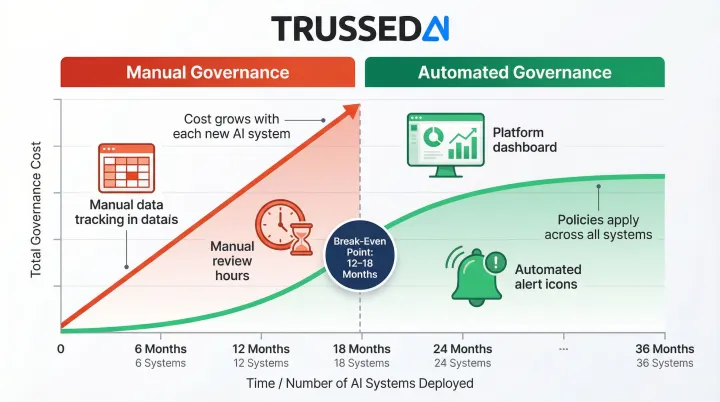
Open-source tools and manual spreadsheet-based governance minimize direct tooling costs but introduce substantial hidden labor costs as deployment scales. Organizations relying on manual processes report that governance teams spend up to 40 hours per week on reviews and approvals.
Commercial governance platforms carry higher licensing costs,ranging from $60,000 for mid-market deployments to over $600,000 for large enterprises,but reduce per-system overhead through automation of monitoring, policy enforcement, and evidence generation. The tradeoff matters: those 40 weekly hours compound quickly across a growing AI portfolio.
That shift is already underway. The global AI governance and compliance software market is projected to reach $8.23 billion by 2034, driven by enterprises moving away from manual processes as their AI footprints expand.
Audit, Certification, and Evidence Generation Requirements
Formal certification pathways carry significant costs in both internal preparation time and external audit fees.
ISO 42001 certification costs by organization size:
| Organization Size | Year-One Cost |
|---|---|
| Small (30 employees) | $73,000 |
| Mid-sized (120 employees) | $180,000–$320,000 |
| Large (500+ employees) | $350,000–$650,000+ |
Annual surveillance audits cost 30–40% of initial certification fees ($8,000–$20,000 annually). Organizations without automated evidence generation must invest significant manual effort in audit preparation,a recurring hidden cost that compounds as AI deployments scale.
Enterprise AI Governance Cost Breakdown: One-Time vs. Recurring
Enterprise AI governance costs split into two buckets: one-time setup investments and recurring operational expenses. Organizations that budget only for setup routinely face mid-year overruns.
Initial Setup (One-Time Costs)
Three categories dominate initial spending:
- Policy framework development ($25,000–$120,000): Defining AI use policies, risk classification frameworks, data handling procedures, and escalation protocols. Mid-to-large enterprises typically need senior technical staff or external specialists.
- Tooling procurement and integration ($60,000–$600,000+): Licensing or configuring governance platforms, integrating them with model serving layers, developer environments, and CI/CD pipelines, and setting up initial monitoring and policy enforcement rules.
- Gap assessment and compliance readiness ($8,000–$25,000): Evaluating the current AI environment against applicable regulatory standards, identifying deficiencies, and remediating them before production governance begins.
Ongoing Operational Costs (Recurring)
Recurring costs scale with the number of AI systems in production and the maturity of your compliance obligations:
- Continuous monitoring and drift detection ($50,000–$300,000+/year): Compute costs for monitoring model performance and compliance, labor for reviewing alerts and incidents, and periodic revalidation of AI system outputs against governance policies.
- Compliance reporting and audit trail maintenance ($30,000–$150,000+/year for manual approaches): Generating evidence for internal and external audits, and maintaining documentation that governance was applied to every AI decision. Manual approaches carry substantial recurring labor costs.
- Governance staff, training, and external expertise ($150,000–$500,000+/year): Dedicated governance roles, ongoing staff training as AI systems and regulations evolve, and periodic external consultations for specialized regulatory requirements.
Automated platforms compress the audit trail cost considerably. Trussed AI's control plane logs policy evaluation results, model version, timestamp, and data lineage for every governed interaction , generating audit-ready evidence without manual reconstruction. For organizations running AI at scale, this can cut compliance reporting labor by roughly 50%.
Manual vs. Automated AI Governance: What's the Real Cost Difference?
The choice between manual governance processes and an automated governance platform is not just a tooling decision,it is a fundamental cost architecture decision. The gap between the two approaches widens significantly as AI deployments scale.
| Manual Governance | Automated Governance | |
|---|---|---|
| Cost scaling | Linear , each new AI system adds labor | Sub-linear , policies apply across systems |
| At 10 AI systems | Manageable with periodic reviews | Higher upfront cost, minimal ongoing labor |
| At 50 AI systems | Unsustainable: spreadsheets, manual audits, constant oversight | Policies enforced at runtime, no proportional headcount increase |
| Audit evidence | Reconstructed manually before each review | Generated automatically as a byproduct of every governed interaction |
| Violation detection | Found during manual reviews | Caught in real time |
A Forrester Total Economic Impact study demonstrated a 333% ROI from governance automation, with automated governance reducing compliance review times by 85% and delivering $10 million in labor efficiencies from faster processes and improved time-to-market.
Those efficiency gains reflect what purpose-built platforms are designed to deliver. Trussed AI's enterprise AI control plane, for instance, reduces manual governance workload by 50% and maintains less than 1% compliance violation rates across governed interactions , enforcing policies continuously rather than catching failures after the fact.
Finding Your Break-Even Point
For organizations managing more than a handful of AI systems , or operating in regulated industries with frequent audit requirements , automated governance becomes the more cost-efficient path within 12–18 months. Calculate your break-even by comparing current manual labor costs (governance FTE hours × loaded hourly rate × number of AI systems) against platform licensing plus reduced labor requirements.
How to Build a Right-Sized AI Governance Budget
The goal of AI governance budgeting is not to minimize spend,it is to match investment to risk profile and deployment reality, avoiding both under-governance (which creates regulatory and operational exposure) and over-governance (which burdens teams without meaningfully reducing risk).
Map Governance Intensity to Deployment Footprint and Risk
Inventory all AI systems in production and classify them by risk level:
- High-risk systems: Customer-facing, regulated data, autonomous decision-making → warrant continuous monitoring, formal audit trails, and real-time policy enforcement
- Medium-risk systems: Internal tools with sensitive data, human-in-the-loop processes → require periodic review and documented oversight
- Low-risk systems: Internal productivity tools, non-sensitive applications → may only require basic policy compliance and quarterly review
Concentrate governance investment where risk is highest, and scale back where it isn't.
Plan for Scale, Not Current State
Governance budgets scoped only for today's AI footprint will be outdated quickly. Model your costs at 2× your current deployment volume and confirm your tooling can absorb that growth without linear cost increases.
The math turns ugly fast with manual approaches: one governance FTE per 10 AI systems means 10 FTEs at 100 systems. Platforms that automate evidence collection and policy enforcement break that linear scaling curve.
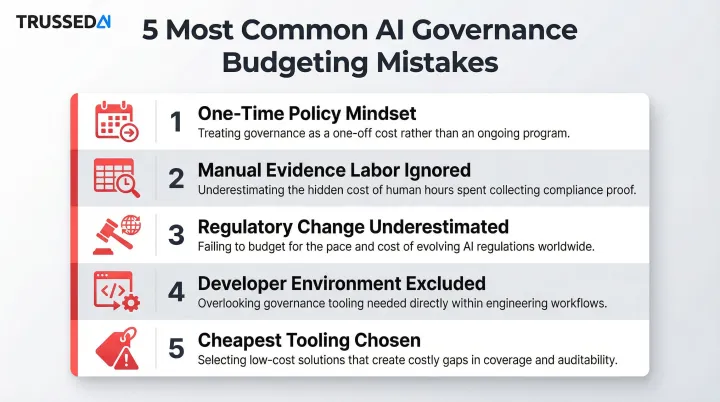
Avoid the Five Most Common Budgeting Mistakes
- Treating governance as a one-time policy exercise rather than a continuous operational cost
- Ignoring the compounding labor cost of manual evidence generation as deployments grow
- Underestimating the cost of regulatory change , new laws require framework updates, staff retraining, and system modifications
- Excluding developer-side governance by enforcing policies only in production while ignoring shadow AI in developer environments, IDEs, and staging systems
- Choosing the cheapest tooling without evaluating long-term reliability, audit defensibility, and the ability to scale sub-linearly
Frequently Asked Questions
What are the considerations of AI governance?
AI governance covers policy definition, risk classification, model monitoring, data handling, regulatory compliance (GDPR, HIPAA, EU AI Act), audit trail generation, and incident response. Running it well requires balancing technical controls with organizational accountability across every AI system in production.
How much does enterprise AI governance cost per year?
Annual costs vary widely: $73,000–$150,000 for small organizations, $180,000–$320,000 for mid-market, and $350,000–$650,000+ for large enterprises. Costs depend on regulatory obligations, number of AI systems governed, and tooling choices. Ongoing operational costs typically represent 10–20% of the overall AI budget.
What is the difference between AI governance and AI compliance?
Compliance is the outcome,meeting specific regulatory requirements like GDPR or the EU AI Act. Governance is the operational system,policies, controls, monitoring, and enforcement,that makes compliance achievable and demonstrable over time. Without governance infrastructure in place, compliance becomes reactive and difficult to prove.
How do AI governance costs scale as deployments grow?
Manual governance scales roughly linearly with each new AI system, requiring proportional increases in headcount and labor hours. Automated governance platforms scale sub-linearly - policies are enforced across all systems without proportional cost increases. This cost divergence makes tooling choices a high-leverage budgeting decision for growing enterprises.
What hidden costs do most organizations miss in AI governance programs?
The most overlooked costs are manual compliance evidence generation, governance of AI in developer environments (not just production), and ongoing regulatory change management. Equally underestimated: the cost of governance failures - fines, operational breaches, and reputational damage that routinely exceed the governance budget itself.
Can AI governance automation tools reduce long-term governance costs?
Yes. Automation reduces per-system governance cost by enforcing policies at runtime and auto-generating audit evidence,eliminating the need to grow governance headcount in step with AI deployment. Organizations report 85% reductions in compliance review times and 50% reductions in manual governance workload with automated platforms.