Introduction
AI adoption is accelerating fastest in the industries where data governance failures carry the steepest costs. Healthcare, insurance, and financial Solution organizations are racing to deploy generative AI,but these are also the sectors where a single compliance misstep can trigger million-dollar fines and irreparable damage to patient trust.
Healthcare data breaches now average $9.77 million per incident, making healthcare the costliest industry for breaches for 13 consecutive years. The HHS Office for Civil Rights has levied over $144.8 million across 152 HIPAA enforcement actions in that same period.
For regulated enterprises, deploying AI without exposing Protected Health Information (PHI) or violating the controls that auditors, regulators, and customers expect is the defining challenge,not AI adoption itself.
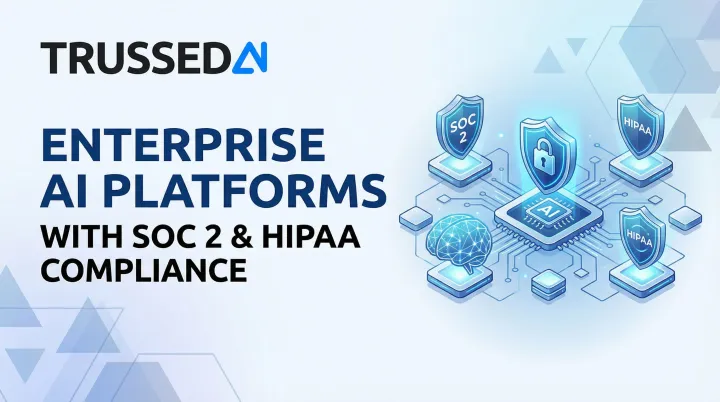
HIPAA compliance is no longer a procurement checkbox. It determines whether sensitive data can legally flow through AI systems at all. This article examines the enterprise AI platforms that meet these standards and explains what compliance really means when AI moves from pilot to production.
Key Takeaways
- Healthcare, insurance, and financial Solution AI platforms must execute a HIPAA Business Associate Agreement (BAA) and demonstrate sustained security controls before any PHI is processed
- Certifications validate past controls; runtime enforcement determines whether platforms stay compliant as AI scales
- Evaluation criteria include BAA availability, data residency controls, deployment architecture and automated evidence generation for auditors
- This review covers five platforms,Trussed AI, Microsoft Azure OpenAI Service, Google Cloud Vertex AI, AWS Bedrock, and Anthropic Claude Enterprise,evaluated against enterprise compliance requirements
What Makes an Enterprise AI Platform Truly HIPAA Compliant
Security Attestation: Why Sustained Controls Matter
Enterprise security attestations come in two forms. Type I validates that security controls are properly designed at a single point in time. Type II goes further: it verifies those controls operated effectively over a sustained audit period, typically 3 to 12 months. Enterprise procurement teams in regulated industries overwhelmingly require Type II because it proves consistent operational security,not just design intent.
For procurement teams, this distinction is decisive: a Type I report tells you the controls existed on one day; a Type II report tells you they held up over months.
HIPAA and the Business Associate Agreement Requirement
Any vendor whose platform receives, processes, or stores Protected Health Information must sign a Business Associate Agreement (BAA). Under 45 CFR 164.502(e) and 164.504(e), covered entities are legally required to obtain satisfactory assurances that business associates will appropriately safeguard PHI.
The BAA covers:
- How PHI is created, received, maintained, or transmitted
- Security safeguards the vendor will implement
- Breach notification obligations
- Subcontractor responsibilities
HHS guidance explicitly states that Cloud Service Providers are Business Associates even if they only process encrypted ePHI and lack the decryption key. The "no-view" defense does not eliminate BAA requirements.
Absence of a BAA is a hard legal blocker , not a risk to accept. The HHS Office for Civil Rights has imposed a $1.55 million settlement on a covered entity for failing to execute a BAA with a major contractor.
The Compliance Gap Certifications Can't Close
An AI platform can offer a BAA and hold security certifications yet still expose PHI if:
- Prompts are logged by default on shared infrastructure
- Model outputs are retained indefinitely
- Agentic workflows create uncontrolled data flows across systems
- No runtime policy enforcement exists to block non-compliant outputs
Runtime governance closes this exposure. Real-time policy enforcement, prompt filtering, and audit trail generation ensure compliance is actively enforced at every interaction , not reconstructed after the fact.
Architectural Considerations Beyond the Certification Badge
Enterprises must evaluate:
- Data residency controls: Where is data processed and stored? Can you enforce region-specific data sovereignty?
- Retention and deletion policies: How long are prompts and completions retained? Can you request deletion on demand?
- Deployment architecture: Does the platform support private VPC or on-premise deployment to isolate PHI?
- Automated compliance evidence: Does the platform generate audit-ready logs as a byproduct of every interaction, or do you reconstruct evidence manually before each audit?
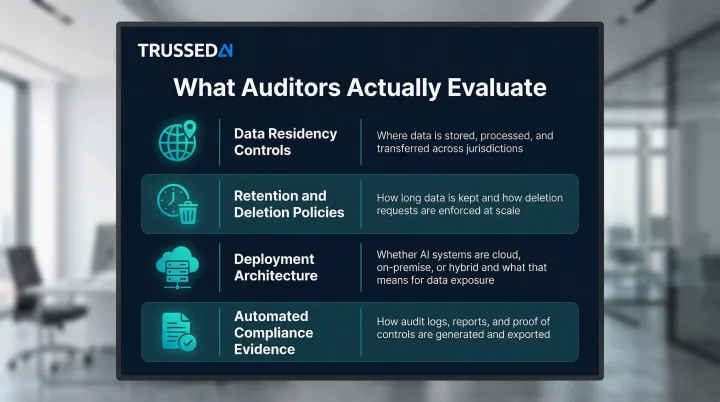
Auditors don't ask whether you had a policy - they ask whether you can prove it was enforced. Platforms that generate compliance evidence automatically at runtime answer that question before the audit begins.
Best Enterprise AI Platforms with HIPAA Compliance
The platforms below were selected based on verified certification status, BAA availability, deployment flexibility, and proven use in regulated enterprise environments.
Trussed AI
Trussed AI is an enterprise AI control plane built specifically to govern AI applications, agents, and developer tools in production. Designed from the ground up for regulated industries including healthcare, insurance, and financial Solution, it functions as a drop-in proxy that enforces compliance at runtime without requiring any changes to application code.
Unlike inference-only platforms, Trussed AI turns static compliance policies into real-time enforcement: blocking non-compliant outputs, routing requests across models, and generating audit-ready evidence as a byproduct of every governed interaction. Documented performance benchmarks include:
- Less than 20ms latency overhead
- Less than 1% compliance violation rate
- 50% reduction in manual governance workload
- Operational workflows live in under 4 weeks
| Category | Details |
|---|---|
| Compliance Certifications | Continuous compliance monitoring with real-time policy enforcement across models, agents, and workflows; aligned to HIPAA, GDPR, FERPA, and NIST AI RMF |
| HIPAA & BAA Support | Designed for regulated industries including healthcare; supports HIPAA-aligned governance controls including audit trail generation and PHI guardrails at runtime |
| Deployment Architecture | Drop-in proxy integration (zero code changes); supports cloud and hybrid deployments; partners with AWS and Google Cloud |
Microsoft Azure OpenAI Service
Microsoft Azure OpenAI Service provides enterprise access to OpenAI models (including GPT-4 and o-series) hosted within Azure's globally distributed infrastructure. It is one of the most widely adopted AI platforms in regulated industries, largely because it inherits Azure's comprehensive compliance portfolio.
Azure OpenAI offers HIPAA BAA coverage under the Microsoft Online Services BAA and private network deployment via Azure Virtual Networks and Private Endpoints. Microsoft Azure covers a broad compliance portfolio that makes it particularly well-suited for healthcare systems and financial institutions with data sovereignty requirements. Customer prompts and completions are not used to train foundation models by default.
| Category | Details |
|---|---|
| Compliance Certifications | FedRAMP High, HITRUST , one of the broadest compliance portfolios among AI inference platforms |
| HIPAA & BAA Support | HIPAA BAA available under Microsoft Online Services agreement; prompt and response data not used to train shared models by default in enterprise tier |
| Deployment Architecture | Azure-hosted with Private Endpoint support; data residency controls by region; content filtering and logging configurable at the API level |
Google Cloud Vertex AI
Google Cloud Vertex AI is Google's unified platform for building, deploying, and managing machine learning and generative AI models at enterprise scale. It provides access to Google's Gemini model family alongside third-party models, all within Google Cloud's compliance-certified infrastructure.
Vertex AI supports HIPAA through Google Cloud's BAA and provides enterprise-grade data isolation through VPC Service Controls , preventing data exfiltration across organizational boundaries. Its model routing and managed API capabilities suit enterprises running AI across multiple business units with different data sensitivity requirements. Google explicitly commits that customer data is not used to train or fine-tune AI/ML models without prior permission.
| Category | Details |
|---|---|
| Compliance Certifications | FedRAMP Moderate/High eligible, HIPAA compliant under Google Cloud BAA |
| HIPAA & BAA Support | HIPAA BAA available; customer data not used for model training; configurable data retention and deletion controls in Vertex AI API |
| Deployment Architecture | Supports VPC Service Controls for data perimeter enforcement; private endpoints available; multi-region deployment with data residency controls |
AWS Bedrock
Amazon Bedrock is AWS's fully managed AI service that provides access to foundation models from Anthropic, Meta, Mistral, and others through a single API. Its deep integration with the AWS security ecosystem means enterprises already running workloads on AWS can extend existing IAM policies, VPC configurations, and logging infrastructure directly to their AI layer.
Bedrock is HIPAA-eligible under AWS's standard BAA and supports deployment within private VPCs with no model provider seeing customer data. Its Guardrails for Amazon Bedrock feature lets enterprises define content policies and PII filtering rules directly at the inference layer , a critical capability for HIPAA-governed workflows. AWS never shares customer data with model providers or uses it to train foundation models.
| Category | Details |
|---|---|
| Compliance Certifications | HIPAA eligible, FedRAMP Moderate; AWS inherits one of the largest compliance portfolios in cloud |
| HIPAA & BAA Support | HIPAA-eligible service covered under AWS BAA; Guardrails feature supports PII detection and redaction at inference; no data shared with model providers |
| Deployment Architecture | Runs entirely within customer's AWS VPC; supports AWS PrivateLink; data does not leave the AWS environment |