Introduction
Regulated industries are caught between two accelerating pressures. Regulatory frameworks keep expanding , HIPAA, GDPR, the EU AI Act, NIST AI RMF , while AI models, agents, and workflows are now making thousands of operational decisions daily inside the same organizations that must comply with them.
Healthcare, financial Solution, and insurance teams are managing dozens of overlapping requirements with tools built before enterprise AI existed. The result is a governance gap that traditional compliance software wasn't designed to close.
Choosing the wrong compliance management software means missed regulatory deadlines, failed audits, and compounding operational risk. According to Gartner, 85% of organizations use more than one GRC tool to meet their compliance needs , a sign of just how fragmented the compliance stack has become. For organizations deploying AI, the exposure runs deeper: when regulators ask how a specific AI decision was governed, most teams need weeks to reconstruct the answer manually, and that's time most audit situations won't allow.
This guide provides a structured framework for evaluating compliance management software that addresses both traditional regulatory obligations and the emerging governance challenges created by enterprise AI deployment.
Key Takeaways
- Compliance management software centralizes policy tracking, risk assessment, audit evidence, and regulatory change management into a unified platform
- Key evaluation factors: regulatory coverage, automation depth, integration flexibility, audit trail quality, AI governance, and scalability
- Effective compliance platforms enforce governance continuously , not only when audits are scheduled
- The right platform cuts manual compliance workload by up to 50% and generates audit evidence automatically
- Match software to your industry, regulatory environment, and tech stack - not just market popularity
What Is Compliance Management Software?
Compliance management software is an integrated system that brings together people, processes, policies, and technology to help organizations meet regulatory requirements, manage risk, and maintain audit readiness. It operates as production infrastructure , tracking compliance state in real time, not just generating reports after the fact.
Modern platforms span multiple use cases including policy lifecycle management, regulatory change tracking, risk assessment, evidence collection, and audit preparation. These systems incorporate AI to automate compliance functions that previously consumed weeks of manual effort.
Core Components of Compliance Management Software
Policy and Regulatory Tracking
Regulatory frameworks - HIPAA, GDPR, NIST AI RMF - change constantly across regions and industries. Manual tracking breaks down at scale. This component keeps internal policies synchronized with those changes automatically.
The stakes vary by sector. Healthcare organizations must track HIPAA alongside state privacy laws and emerging AI regulations, while financial Solution firms navigate PCI-DSS, data sovereignty requirements, and operational resilience mandates. The platform flags relevant regulatory updates and maps them to existing policies.
Risk Assessment and Controls Management
This function is what separates reactive compliance from proactive compliance. The system maps business processes and assets to specific controls, scores risk exposure, and flags gaps before they become violations.
Critically, it evaluates which controls apply to specific AI interactions, data flows, or business processes , then monitors whether those controls are actually enforced. Without this mapping, organizations can't demonstrate that policies exist in practice, not just on paper.
Audit Trail and Evidence Collection
Audit-ready documentation must be generated continuously, not assembled under pressure before an audit. An automated evidence pipeline captures policy evaluation results, timestamps, model versions, and data lineage as a byproduct of normal operations.
When regulators ask how a specific decision was governed, the system should provide complete chain of custody instantly - from initial request through processing to final action - without requiring weeks of manual reconstruction.
Benefits for Regulated Organizations
Modern compliance management software delivers measurable operational benefits:
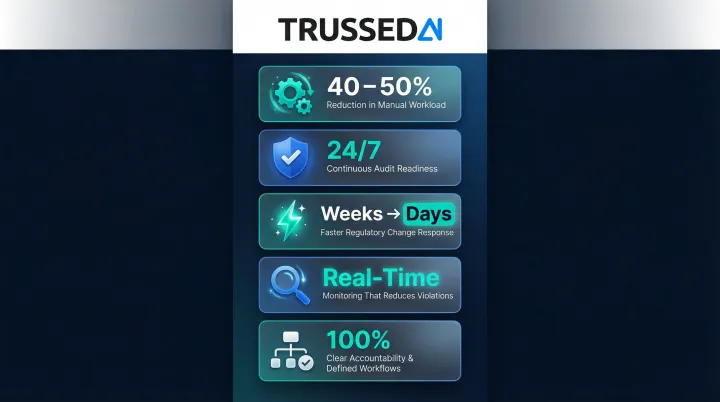
- Reduces manual workload by 40-50% through automated policy enforcement and evidence generation
- Maintains continuous audit readiness rather than periodic compliance sprints
- Accelerates response to regulatory changes from weeks to days
- Decreases compliance violations through real-time monitoring and enforcement
- Establishes clear accountability across teams with defined approval workflows
What to Consider When Evaluating Compliance Management Software
The right compliance platform depends on aligning technical capabilities to your organization's specific regulatory obligations, risk profile, and existing technology stack. A tool that works well for a fintech startup may be inadequate for a healthcare enterprise managing HIPAA compliance across multiple AI-powered clinical systems.
The following six factors help translate feature lists into measurable compliance outcomes and risk reduction.
Factor 1: Regulatory Framework Coverage
Framework coverage matters because a platform that doesn't support the specific standards your organization is subject to creates blind spots that no amount of automation can compensate for. If your healthcare organization must comply with HIPAA, but the platform only offers generic healthcare templates without specific HIPAA control mappings, you'll spend months building custom frameworks manually.
Evaluate how frequently the vendor updates its framework library. Regulatory requirements shift constantly,the EU AI Act, state privacy laws, and industry-specific guidance change quarterly. Stale framework coverage only reveals itself when auditors find the gaps, and by then remediation is costly.
Also check whether the platform can incorporate custom frameworks and internal policies. Most enterprises have governance standards that go beyond regulatory minimums; the platform should handle these without requiring extensive custom development.
Factor 2: Automation Depth and Real-Time Monitoring
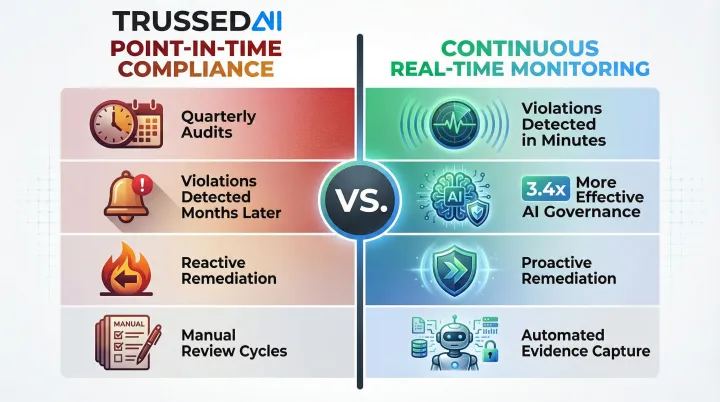
Traditional compliance relies on point-in-time checks - quarterly audits, annual certifications, periodic reviews. Real-time monitoring prevents violations from going undetected between audit cycles. Point-in-time compliance tells you where you were. Continuous monitoring tells you where you are.
This factor affects critical KPIs: mean time to detect a compliance gap, number of manual review hours per cycle, and the ratio of proactive versus reactive remediation actions. Organizations with real-time monitoring identify control failures within minutes rather than months, enabling immediate remediation before violations compound. According to Gartner research, organizations deploying dedicated AI governance platforms with continuous monitoring are 3.4 times more likely to achieve high effectiveness in AI governance.
Factor 3: Integration With Existing Systems
Compliance software that cannot connect to the systems where work actually happens - cloud infrastructure, DevOps pipelines, data platforms, identity providers - forces manual data transfers that introduce delay and error. If your compliance platform can't pull configuration data from AWS, Azure, or Google Cloud automatically, compliance teams must manually verify that security controls match documented policies.
When evaluating vendors, ask a direct question: does their platform connect to your current stack natively, or only through custom development? The answer matters more than it sounds:
- Native integrations (cloud providers, Okta, Jira) mean compliance monitoring runs automatically
- Custom integrations require ongoing maintenance and become fragile as your stack evolves
Factor 4: Audit Trail Quality and Evidence Generation
Regulators and auditors require demonstrable, timestamped records of how controls were applied - not a summary document prepared after the fact. The platform should generate evidence automatically as a byproduct of governed operations. Every policy evaluation, access decision, and AI interaction should be logged with full context:
- Who made the request
- Which policies were evaluated
- What decision was reached
- What action was taken
This affects both the cost of preparing for an audit and the risk of evidence gaps that can invalidate a certification or invite regulatory scrutiny. Organizations that maintain continuous audit trails respond to regulatory inquiries in hours rather than weeks, and demonstrate compliance through actual system records rather than reconstructed narratives.
Factor 5: AI Governance and Runtime Policy Enforcement
As organizations deploy AI systems, models, and autonomous agents across production environments, these AI-generated actions and decisions must themselves be governed, logged, and auditable. Most traditional compliance platforms were not designed for this challenge. They can track whether you have an AI acceptable use policy, but they cannot enforce that policy when an AI agent attempts to access sensitive data or trigger a workflow.
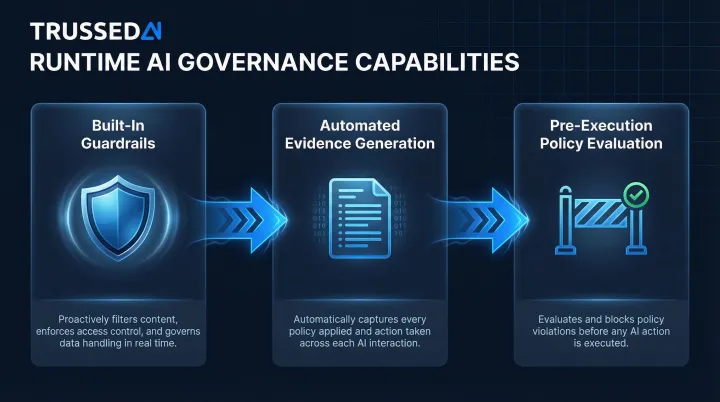
Look for runtime enforcement,not just configuration-time checks. Key capabilities to require:
- Built-in guardrails for AI model behavior: content filtering, access control, data handling rules
- Automated evidence generation for every AI interaction, capturing which policies ran and what action was taken
- Pre-execution policy evaluation, so violations are prevented rather than logged after the fact
Platforms like Trussed AI address this gap specifically by acting as a control plane that intercepts and governs AI operations in real time. Rather than auditing AI decisions after they occur, runtime enforcement evaluates policies before actions execute,preventing violations rather than documenting them after the fact.
Factor 6: Scalability and Deployment Model
Compliance requirements grow with the organization,more jurisdictions, more products, more AI systems. The platform must scale without requiring proportional increases in headcount or infrastructure investment. A compliance system that requires manual configuration for every new regulatory requirement or AI model becomes a bottleneck rather than an enabler.
Ask whether the vendor supports multi-tenant enterprise deployments, hybrid or private cloud environments, and low-latency operation for production systems where compliance checks cannot introduce meaningful performance overhead. Healthcare organizations operating in hybrid cloud environments - which held the largest revenue share in 2024 - need platforms that keep sensitive patient data on-premises while leveraging cloud analytics. Financial Solution firms subject to operational resilience mandates may require multi-region failover capabilities to maintain compliance during cloud outages.
The Role of AI in Modern Compliance Management
AI enables a fundamental shift: from scheduled compliance reviews to continuous, real-time monitoring. AI-powered platforms can scan thousands of regulatory documents, flag relevant changes, and update control mappings automatically, replacing work that previously consumed weeks of manual effort. This automation addresses the reality that regulatory frameworks now change quarterly rather than annually, making manual tracking unsustainable at enterprise scale.
AI delivers the most compliance value in three specific functions:
- Regulatory change classification , determines which provisions of a new state privacy law or federal agency update apply to your organization based on industry, jurisdiction, and existing obligations. Compliance teams spend less time reviewing every regulatory update and more time acting on the ones that matter.
- Predictive risk scoring , analyzes patterns across policy evaluations, access requests, and system configurations to identify control gaps or anomalous behavior before they become violations. This shifts compliance from reactive remediation to proactive risk management.
- Automated evidence generation , captures policy evaluations, access decisions, and system configurations continuously as operations occur, so audit documentation exists without manual compilation when auditors arrive.
However, AI also creates a new compliance challenge: when AI models, agents, and automated workflows make decisions in production, those decisions need to be governed in real time. This requires a new class of compliance tooling that monitors not just the organization's compliance posture, but the behavior of its AI systems.
Traditional compliance software can track whether you have an AI governance policy. AI governance platforms , like Trussed AI , enforce that policy at the moment an AI system attempts to take action.
Maintaining human-in-the-loop oversight remains critical. AI should accelerate compliance analysis and surface risks, but compliance officers must retain accountability for regulatory strategy and ethical judgment. Evaluate vendors on how they support this balance, not just on claims of full automation. The goal is AI-assisted compliance analysis , not autonomous compliance decision-making.
How Trussed AI Can Help
Trussed AI was built to close the governance gap that opens when organizations deploy AI at scale in regulated environments. Existing compliance software tracks policy adherence , but it has no visibility into what AI models, agents, and workflows are actually doing in production.
Trussed acts as a drop-in proxy, enforcing governance policies at runtime across AI applications, agents, and developer tools with no changes to application code. Every governed interaction automatically generates audit-ready evidence. Organizations using the platform see less than 1% compliance violations and a 50% reduction in manual governance workload.
Key capabilities:
- Real-time policy enforcement across models and agents, evaluating governance before actions run
- Continuous compliance monitoring with complete audit trails capturing policy evaluation results, timestamps, and data lineage
- Intelligent routing and failover to maintain SLAs while enforcing governance policies
- Full stack visibility including developer environments and production systems
- Operational readiness in under four weeks
Conclusion
The goal is not to find the most feature-rich or widely marketed compliance platform, but to identify the one that matches your organization's specific regulatory obligations, technology environment, and operational risk tolerance. A healthcare enterprise managing HIPAA compliance across AI-powered clinical systems has very different requirements than an insurance company automating underwriting decisions or a financial Solution firm subject to operational resilience mandates.
Compliance is a continuous operational discipline, not a one-time certification event. The platform selected today must be re-evaluated periodically as regulatory requirements evolve and as AI deployment introduces new governance obligations that traditional tools were not designed to address.
Organizations that approach compliance software selection as a strategic infrastructure decision , rather than a vendor procurement exercise , build the adaptability to keep pace with both regulatory change and AI complexity. A practical starting point: schedule a formal compliance platform review annually, and trigger an unscheduled review any time your AI deployment scope or applicable regulatory frameworks change significantly.
Frequently Asked Questions
What is compliance management software?
Compliance management software is an integrated system of tools, processes, and policies used to track regulatory requirements, manage risk, collect audit evidence, and maintain ongoing adherence to applicable standards. Unlike a periodic checklist tool, it functions as operational infrastructure that monitors compliance continuously.
How is AI used in compliance management?
AI automates regulatory change monitoring by scanning thousands of regulatory documents and generating risk scores to surface emerging compliance exposures before they become violations. It also produces audit evidence automatically as a byproduct of governed operations. AI now enforces governance policies over AI systems themselves in real time, ensuring AI-generated decisions comply with organizational and regulatory requirements.
What are the 5 key areas of compliance?
The five core compliance domains are:
- Regulatory and legal: adherence to laws and industry regulations
- Data privacy and security: protecting sensitive information
- Operational and process: following internal procedures and controls
- Financial and reporting: accurate financial disclosures
- AI/technology governance: governing automated decision systems
The relative weight of each area varies by industry - healthcare prioritizes data privacy, while financial Solution emphasizes operational resilience.
What is the difference between traditional compliance software and AI governance platforms?
Traditional compliance software tracks whether policies and controls are documented and followed, typically through periodic audits and reviews. AI governance platforms like Trussed AI actively intercept and enforce policies at the moment AI systems make decisions in production, evaluating governance before actions execute rather than documenting outcomes after the fact. This addresses a gap traditional tools cannot fill: governing AI behavior in real time.
How long does it typically take to implement compliance management software?
Implementation timelines vary based on platform architecture and organizational complexity. Legacy GRC platforms can require months of onboarding, involving extensive custom development and cross-functional coordination. Modern cloud-native platforms can reach operational workflows in as little as four weeks, with end-user training measured in hours rather than weeks.