Introduction
Organizations are deploying AI applications, agents, and workflows faster than governance frameworks can keep pace. According to McKinsey's 2025 global survey, 88% of organizations now regularly use AI in at least one business function, yet 51% report experiencing at least one negative consequence such as inaccuracy, data breaches, or compliance violations. For regulated industries, that gap translates directly into audit failures, operational breakdowns, and mounting regulatory exposure.
AI TRiSM (AI Trust, Risk, and Security Management) - Gartner's structured framework - has become the enterprise standard for closing this gap. The market reflects the urgency: Forrester projects AI governance software spending will reach $15.8 billion by 2030 at a 30% compound annual growth rate.
A growing ecosystem of specialized tools now supports adoption across the framework's four layers: AI governance, runtime inspection and enforcement, information governance, and infrastructure and stack.
This guide profiles the top AI TRiSM vendors for model risk and compliance, walks through the evaluation criteria that matter most, and helps you match the right tool to your organization's specific governance requirements.
Key Takeaways
- AI TRiSM is Gartner's framework for governing AI systems across four layers - from policy enforcement and runtime inspection to data security and infrastructure controls
- Generative AI adoption and regulations like the EU AI Act and NIST AI RMF are driving rapid expansion of the AI TRiSM market
- Top tools vary by focus - lifecycle governance, runtime enforcement, data security, or audit-readiness - so selection should align with your primary risk exposure
- Evaluate tools on real-time policy enforcement capability, compliance framework coverage, integration simplicity, and automated audit evidence generation
- Each vendor reviewed here maps to specific AI TRiSM layers, with a focus on enterprise deployment readiness and regulated industry use cases
What Is AI TRiSM and Why Do Enterprises Need It Now?
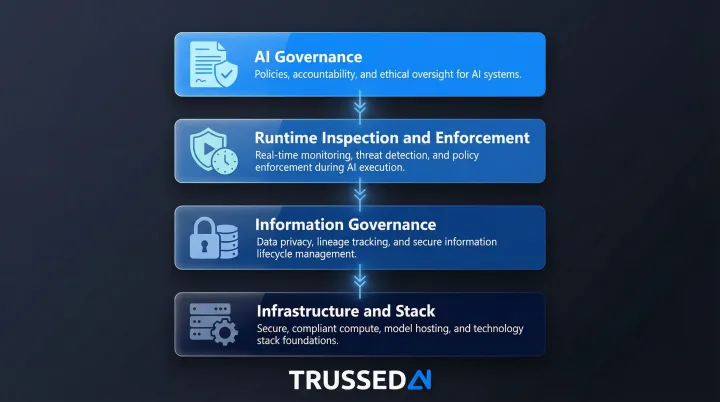
AI TRiSM is Gartner's framework for ensuring AI governance, trustworthiness, fairness, reliability, and data protection. Unlike traditional IT or data governance, AI TRiSM is built around four core technology layers:
- AI Governance , policies, documentation, and lifecycle oversight
- Runtime Inspection and Enforcement , real-time monitoring and policy enforcement during AI interactions
- Information Governance , data access controls, lineage, and privacy protection
- Infrastructure and Stack , secure deployment environments and technical controls
As AI models and autonomous agents get embedded in critical business processes, the risks compound quickly - model drift, data leakage, regulatory violations, and adversarial attacks don't wait for governance programs to catch up. Gartner officially recognized AI TRiSM as a critical framework in its 2025 Hype Cycle for Artificial Intelligence, noting it plays a "crucial role in ensuring ethical and secure AI deployment."
That recognition is now backed by regulation.
The EU AI Act began enforcing prohibitions in February 2025, with full high-risk system requirements taking effect in August 2026. The NIST AI Risk Management Framework and ISO/IEC 42001 standard for AI Management Systems provide additional frameworks that organizations must operationalize.
The vendors profiled below are evaluated on how well they help organizations in financial Solution, healthcare, and insurance operationalize these frameworks , turning policy documents into enforceable runtime controls before an audit or incident forces the issue.
Top AI TRiSM Tools for Model Risk and Compliance
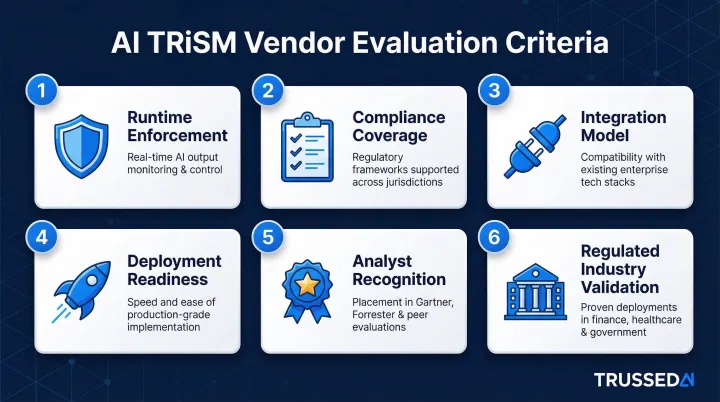
Vendors were evaluated based on alignment with Gartner's AI TRiSM layers, enterprise deployment readiness, compliance framework coverage, and suitability for regulated industries. No single tool covers every use case equally. Selection depends on your primary risk exposure.
Evaluation criteria used across all entries:
- Governance scope: Does the tool operate at runtime, lifecycle, or both?
- Compliance coverage: Which frameworks does it support (NIST AI RMF, EU AI Act, HIPAA, etc.)?
- Integration model: How does it connect to existing enterprise systems?
- Deployment readiness: Time to value and operational overhead required
Trussed AI
Trussed AI is an enterprise AI control plane that enforces governance, security, and operational policy across AI applications, agents, developer tools, and workflows at runtime. It targets the production deployment problem: most governance frameworks apply before or after AI runs, not during. Trussed operates at the execution layer.
Key differentiators include:
- Drop-in proxy integration , zero application code changes required; developers swap their API endpoint
- Real-time policy enforcement at the execution layer with minimal latency impact
- Complete audit trails generated automatically, capturing policy evaluation results, model versions, timestamps, and data lineage
- Continuous compliance monitoring with automated evidence generation structured for regulatory examination
- Framework support for NIST AI RMF, HIPAA, GDPR, and FERPA
| Attribute | Details |
|---|---|
| Key Features | Real-time runtime policy enforcement across models, agents, and developer tools; intelligent routing and failover; automatic audit evidence generation; cost tracking and attribution by team, model, and application |
| Ideal For | Enterprises in insurance, healthcare, financial Solution, and universities deploying generative AI and agentic AI systems at scale who need production-ready governance with minimal engineering overhead |
| Pricing / Availability | Contact Trussed AI directly; operational workflows reported live in under 4 weeks |
ModelOp
ModelOp is an enterprise AI governance platform recognized in Gartner's 2025 Market Guide for AI Governance Platforms. It focuses on full AI lifecycle management,from model inventory and risk tiering to compliance reporting and workflow approvals,and is used by large financial institutions and healthcare organizations.
Strengths include:
- Technology-agnostic integration with existing IT, GRC, and data governance systems including AWS SageMaker, Azure, ServiceNow, and Jira
- Automated model documentation and risk scoring across internally built and third-party AI models including generative AI
- Structured governance workflows for model intake, approval, monitoring, and retirement
- Enterprise validation including a Gartner case study on Fidelity Investments demonstrating ModelOp's framework adoption
| Attribute | Details |
|---|---|
| Key Features | AI system of record with full model inventory; automated policy controls and compliance tracking; lifecycle management from intake through retirement; reporting and audit-ready evidence generation |
| Ideal For | Large enterprises needing end-to-end AI lifecycle governance across diverse model types, including third-party and SaaS AI systems, with deep integration into existing enterprise GRC workflows |
| Pricing / Availability | Not publicly listed; request a demo via ModelOp's website; Gartner Market Guide recognized |
BigID
BigID offers AI TRiSM capability built on top of its established data security and privacy platform. It provides shadow AI discovery, AI asset inventory tied to data lineage, and automated policy enforcement mapped to frameworks including NIST AI RMF and the EU AI Act.
Strengths include:
- Discovery-first approach that uncovers unsanctioned AI tools and models across cloud and SaaS environments
- Strong data access governance and least-privilege enforcement for prompts and models
- Unified data and AI governance well-suited for organizations where data lineage and AI compliance need integration
- Analyst recognition as a Leader in Forrester's Privacy Management Software Wave (Q4 2025)
Public user feedback notes tuning complexity in large environments as a consideration during deployment.
| Attribute | Details |
|---|---|
| Key Features | Shadow AI discovery; central AI asset inventory with lineage; AI access governance; automated compliance mapping to NIST AI RMF and EU AI Act; risk detection and remediation workflows |
| Ideal For | Enterprises already using BigID for data security or privacy who want AI governance tied directly to data discovery, lineage, and access controls |
| Pricing / Availability | Custom enterprise contracts; contact BigID for quote; trial options reportedly available |
AllTrue.ai (Acquired by Varonis)
AllTrue.ai offers a unified AI TRiSM hub focused on end-to-end AI asset cataloging, continuous monitoring, compliance automation, and runtime guardrails across models, pipelines, and applications. Varonis announced the acquisition of AllTrue.ai in February 2026 for $126 million to extend security and runtime guardrails for AI agents.
Strengths include:
- Automated AI asset discovery across models and pipelines
- Prebuilt compliance assessments mapped to NIST AI RMF and ISO 42001
- Runtime guardrails for LLMs, agents, and RAG systems via an LLM-agnostic gateway
- Supply chain risk checks for third-party AI components
- Consolidated control plane reducing overhead of managing multiple point tools, particularly well-suited for mid-market or scaling teams
Independent enterprise-scale validation remains limited as of 2025.
| Attribute | Details |
|---|---|
| Key Features | Automated AI catalog across models and pipelines; continuous drift and safety monitoring; compliance automation with auditor-ready reports; runtime guardrails for LLMs and agents; third-party AI supply chain risk checks |
| Ideal For | Mid-market enterprises and growing teams that want a consolidated TRiSM hub covering inventory, monitoring, compliance, and runtime controls without stitching together multiple tools |
| Pricing / Availability | Custom enterprise quotes; contact AllTrue.ai directly |
Portal26
Portal26 is a GenAI governance and TRiSM platform built for regulated enterprises and public sector organizations that require detailed forensic auditability of AI usage. It provides shadow AI discovery, risk scoring, policy enforcement via proxy, and audit-grade prompt and response retention for legal and regulatory discovery.
Strengths include:
- Forensic-grade prompt retention aligning with legal guidance that GenAI prompts may be discoverable records in litigation
- Strong GenAI usage visibility and shadow AI discovery capabilities
- AWS Marketplace procurement availability for streamlined enterprise purchasing
- Public sector distribution through Carahsoft partnership announced September 2024
Enterprise pricing can be significant,AWS Marketplace listing notes pricing is based on contract duration and terms.
| Attribute | Details |
|---|---|
| Key Features | Shadow AI and GenAI usage visibility; risk scoring and policy management; forensic prompt and response retention; preventative policy enforcement via proxy; audit and compliance reporting |
| Ideal For | Regulated enterprises and public sector organizations needing forensic-level auditability of GenAI interactions and compliance with legal discovery requirements |
| Pricing / Availability | Available via AWS Marketplace with enterprise contract pricing; public sector via Carahsoft; contact for custom quotes |
Key Capabilities to Look for in an AI TRiSM Tool
Real-Time Runtime Enforcement vs. Post-Hoc Governance
Gartner explicitly distinguishes between offline AI governance functions and "AI runtime inspection and enforcement," which focuses on real-time AI interactions. Tools that intercept and enforce policies at the moment of AI interaction (runtime) prevent violations before they occur, while lifecycle-focused tools document and audit retrospectively.
Palo Alto Networks notes that runtime inspection is the core of TRiSM because it evaluates interactions in real time using technical controls rather than manual review. Enterprises should evaluate which gap is most urgent: preventing violations in production systems (runtime) or ensuring comprehensive documentation for audits (lifecycle). Most mature programs need both - the question is which to prioritize first.
Compliance Framework Coverage
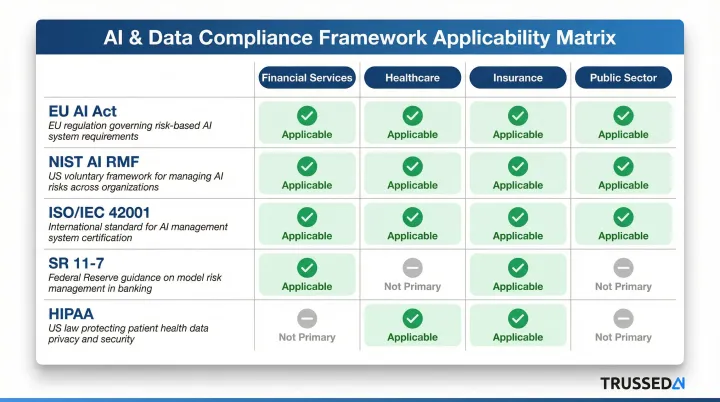
Look for tools that explicitly map to relevant regulations and standards for your industry:
- EU AI Act , high-risk system requirements, transparency obligations, and prohibited practices
- NIST AI RMF , Govern, Map, Measure, and Manage functions
- ISO/IEC 42001 , certifiable AI management system standard
- SR 11-7 , Federal Reserve model risk management guidance for banking
- HIPAA , protected health information requirements for healthcare
The strongest platforms generate audit-ready evidence automatically , no separate documentation step required. They map policy enforcement directly to regulatory requirements, keeping compliance current rather than treating it as a checkpoint exercise.
Agentic AI and Multi-Model Support
Governance tools must cover not just individual models but entire agent pipelines and tool-use chains. Deloitte highlights that traditional IT governance frameworks fail to account for autonomous AI systems that make independent decisions , a gap most first-generation TRiSM tools weren't built to close.
Evaluate whether tools can enforce policies across:
- Agent-to-agent communication
- Tool calls and API requests made by agents
- Shared memory and context across agent workflows
- Multi-step reasoning chains
Integration Without Disruption
AI TRiSM tools should integrate with existing infrastructure , cloud platforms, MLOps pipelines, GRC systems, identity management , without requiring teams to rebuild workflows around them. A 2025 PwC survey found that 50% of executives cite translating Responsible AI principles into operational processes as their biggest barrier to progress.
Time-to-governance is a practical consideration, especially for teams already running AI in production. Look for:
- Drop-in proxy or SDK-based integration
- Support for externally managed and SaaS-based AI models, not just internally hosted ones
- Native integrations with cloud providers (AWS, Azure, Google Cloud)
- Minimal changes to developer workflows
Audit Trail Automation
Compliance in regulated industries requires complete, tamper-evident records of AI decisions and policy enforcement. Look for tools that generate governance evidence as a byproduct of normal operations rather than as a separate manual step.
Key capabilities include:
- Full chain of custody from prompt to model to output to action
- Policy evaluation results with timestamps and model versions
- Data lineage tracking
- Instant availability for internal reviews and regulatory examination
How We Chose These AI TRiSM Vendors
We evaluated vendors against Gartner's four AI TRiSM layers - AI governance, runtime inspection, information governance, and infrastructure/stack - with additional weight given to enterprise deployment readiness and demonstrated use in regulated industries. Criteria were chosen to reflect what actually matters in production, not just what looks good on a spec sheet.
A common mistake when choosing AI TRiSM tools is selecting based on feature lists alone without accounting for:
- How much engineering effort is required to deploy the tool in production
- Whether runtime enforcement introduces latency that disrupts user experience
- Whether the tool covers SaaS-based AI systems, not just internally hosted models
With those gaps in mind, we applied three additional criteria to distinguish vendors with real-world traction from those that are pre-production only:
- Clear pricing models available without a lengthy sales cycle
- Analyst recognition, customer references, or published case studies from independent sources
- Documented deployments in regulated industries under production conditions
Teams should run proof-of-concept evaluations in production-like conditions and verify certifications such as ISO/IEC 42001 compliance rather than relying on vendor self-attestation.
Conclusion
As AI deployments scale into production across regulated industries, the gap between deployment velocity and governance capability creates real exposure - regulatory risk, operational fragility, and rising costs that compound quietly until they don't. AI TRiSM tools give enterprises the runtime controls to close that gap before it becomes a liability.
The right tool depends on where your risk is concentrated. Organizations dealing with shadow AI or data leakage exposure may prioritize discovery-first platforms like BigID or Portal26. Those running agentic AI in production should look for runtime enforcement and audit automation, where Trussed AI and AllTrue.ai are strong options. Enterprises managing diverse model types across business units may find ModelOp's system-of-record approach the most comprehensive fit.
For regulated enterprises that need production-ready governance without engineering overhead, Trussed AI's control plane enforces policy at runtime across models, agents, and developer tools, with no code changes required. Reach out to learn more.
Frequently Asked Questions
What are the top platforms for ensuring enterprise AI compliance?
Leading platforms include ModelOp for lifecycle governance, BigID for data-tied AI compliance, Portal26 for forensic auditability, AllTrue.ai for unified control, and Trussed AI for runtime policy enforcement. The right choice depends on whether your primary need is lifecycle documentation, runtime controls, or discovery.
What is the best AI for risk management?
The right tool depends on the risk type you're managing: ModelOp and AllTrue.ai address lifecycle and compliance risk; Trussed AI and Portal26 address runtime and operational risk; BigID addresses data and access governance risk. Enterprises in regulated industries should evaluate tools against frameworks like NIST AI RMF and SR 11-7.
What is an example of AI TRiSM?
A financial Solution firm deploying a credit scoring model uses an AI TRiSM tool to enforce data access policies at runtime, automatically log model decisions for regulatory audit, and trigger alerts when model output distribution drifts,covering governance, runtime inspection, and information governance across all three TRiSM disciplines at once.
What is the difference between AI TRiSM and traditional AI governance?
Traditional AI governance focuses on policies, documentation, and lifecycle oversight before and after deployment. AI TRiSM, as defined by Gartner, extends this to include runtime inspection and enforcement, information governance, and infrastructure security. The result is an operational discipline, not just a policy exercise.
How do AI TRiSM tools help with regulatory compliance in industries like healthcare or financial Solution?
AI TRiSM tools automatically generate audit trails, map AI behavior to frameworks like HIPAA, SR 11-7, and the EU AI Act, and enforce data access policies in real time. They produce the documentation regulators need to confirm AI systems are monitored, explainable, and corrected when problems surface.