Introduction
Enterprise AI deployment is outrunning governance capacity. Organizations are rolling out AI applications, autonomous agents, and multi-model workflows faster than their risk controls can track. A 2026 market analysis found the AI governance market growing from $308.3 million in 2025 to a projected $3.59 billion by 2033, a 36% annual growth rate driven by regulatory pressure and operational risk.
The risks are concrete. Regulatory exposure under frameworks like the EU AI Act (enforcement begins August 2026) and NIST AI RMF creates audit liability in healthcare, insurance, and financial Solution. Ungoverned AI decisions also threaten SLAs and customer trust in ways traditional tools weren't designed to catch.
Traditional GRC platforms built for SOX audits or IT compliance cannot govern dynamic AI outputs, LLM interactions, or agentic workflows operating without human oversight.
This guide compares the 5 best AI GRC platforms for 2026 based on runtime control capabilities, regulatory alignment, and enterprise readiness. Risk and compliance leaders will find a direct comparison to identify the right fit for their AI stack.
Key Takeaways
- AI GRC platforms enforce policies and generate audit evidence at runtime across models, agents, and workflows
- Traditional GRC tools weren't built for dynamic AI outputs, algorithmic bias, or autonomous agent behavior
- These 5 platforms were selected for runtime enforcement, regulatory coverage, integration simplicity, and fit for regulated industries
- Trussed AI, Credo AI, Holistic AI, IBM OpenPages, and MetricStream each serve a distinct use case across the enforcement-to-documentation spectrum
- Pick based on whether you need runtime AI control, lifecycle documentation, risk scoring, or enterprise GRC integration
What Is an AI GRC Platform?
AI GRC is a distinct category from traditional governance, risk, and compliance tools. Where legacy platforms govern business processes and IT controls, AI GRC platforms manage the obligations arising specifically from deployed AI systems, including large language models, machine learning models, and autonomous agents.
Traditional GRC tools fall short for AI because they were designed for static controls and periodic audits. Gartner analysts note that legacy GRC platforms "are simply not equipped to handle the unique risks of AI, from real-time decision automation to the threat of bias and misuse." AI systems produce dynamic, probabilistic outputs that require continuous monitoring, real-time policy enforcement, and model-level audit trails. Traditional compliance software offers none of these.
A modern AI GRC platform should cover three functional layers:
- Policy definition and enforcement across models and agents
- Continuous monitoring and compliance evidence generation that operates at runtime, not just during annual audits
- Integration with existing enterprise security and audit infrastructure without requiring application re-architecture
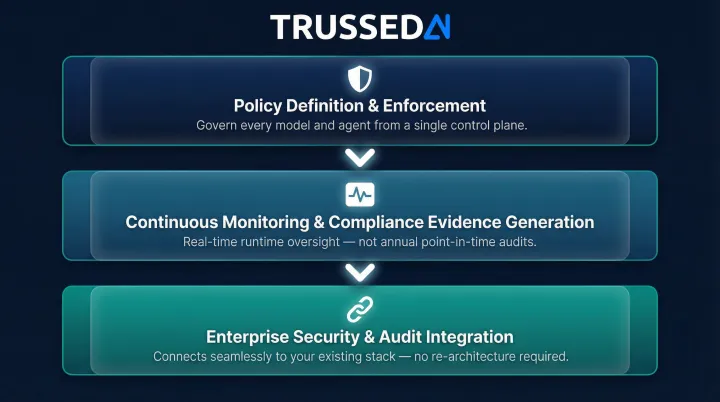
Each of those layers points to the same underlying divide: documentation-only governance versus runtime enforcement. Legal and compliance experts emphasize that when regulators demand proof of model integrity or nondiscrimination, they need outputs from a functioning risk management framework, not a static policy document.
5 Best AI GRC Platforms for 2026
The following platforms were evaluated on runtime control depth, regulatory framework support, deployment simplicity, and fit for regulated industries including insurance, healthcare, and financial Solution.
Trussed AI
Background: Trussed AI is an enterprise AI control plane built to enforce governance, security, and operational control for organizations deploying AI at scale. Founded by veterans from Google Cloud, AWS, Adobe, Microsoft, and JustAnswer, and backed by seed funding led by ManchesterStory, Trussed serves regulated industries including insurance, healthcare, and financial Solution. The platform is built for regulated enterprises in insurance, healthcare, and financial Solution.
Differentiator: Trussed AI is the only platform in this list that enforces governance at runtime, acting as a drop-in proxy between applications and AI models with zero application code changes required. The platform sits in the execution path of every AI interaction, evaluating and enforcing policies before requests reach models and before responses return to applications.
Key capabilities include:
- Real-time policy enforcement across models, agents, and developer tools
- Intelligent routing and failover to maintain enterprise SLAs when models degrade or fail
- Continuous compliance monitoring with audit-ready evidence generated automatically as a byproduct of every governed interaction
- Real-time cost tracking and attribution across teams, models, and applications
- Agentic AI governance that authorizes every tool call and API request before execution
The company reports customer outcomes of 50% reduction in manual governance workload, 50% increase in regulatory compliance, less than 20ms latency, and less than 1% compliance violations based on early customer deployments.
| Category | Details |
|---|---|
| Key Features | Real-time policy enforcement, drop-in proxy integration, automated audit trails, intelligent routing and failover, cost attribution, agentic AI governance |
| Best For | Regulated enterprises (insurance, healthcare, financial Solution) deploying AI in production and needing runtime control without re-architecting existing applications |
| Pricing / Deployment | Contact Trussed AI for enterprise pricing; deploys in under 4 weeks per vendor documentation |
Credo AI
Background: Credo AI is an AI governance platform built to help organizations translate regulatory requirements into operational documentation, assessments, and controls. The platform is particularly strong in aligning AI programs with EU AI Act requirements, NIST AI RMF, and ISO/IEC 42001. Credo AI was named a Leader in The Forrester Wave: AI Governance Solutions, Q3 2025.
Differentiator: Credo AI guides teams through structured AI impact assessments and model documentation workflows, making it a strong fit for compliance-heavy organizations that need to demonstrate regulatory adherence to auditors and regulators. Key capabilities include an AI Registry with shadow AI discovery, continuous risk intelligence with automated red-teaming and drift detection, and GAIA (Govern AI Assistant) agents that continuously evaluate agent traces for policy violations and enable human-in-the-loop escalation.
| Category | Details |
|---|---|
| Key Features | AI impact assessments, model documentation, regulatory framework mapping (EU AI Act, NIST AI RMF, ISO 42001), policy management, runtime enforcement via GAIA agents, shadow AI discovery |
| Best For | Organizations that need to build a documented AI governance program and demonstrate compliance to regulators or auditors, especially in the EU or for high-risk AI use cases |
| Pricing / Deployment | Contact Credo AI for pricing; SaaS deployment model |
Holistic AI
Background: Holistic AI is an AI risk management platform focused on end-to-end lifecycle assessment of AI systems, covering safety, fairness, performance, robustness, and operational risk. The platform was named a Gartner Cool Vendor for AI Security in November 2024 and is designed for organizations running multiple AI systems across business units.
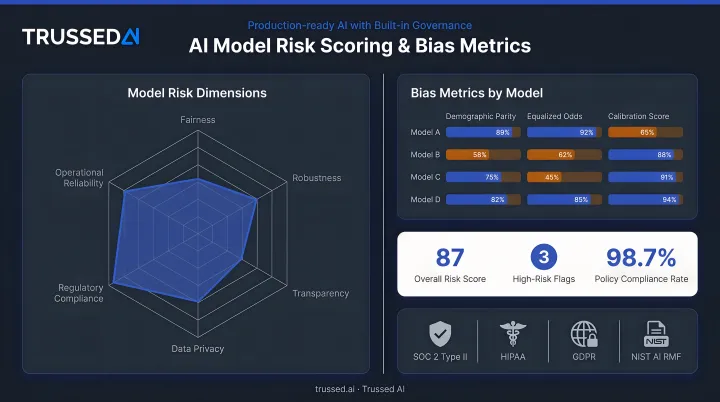
Differentiator: Holistic AI's strength is its depth in risk scoring, evaluating AI models across multiple risk dimensions including bias, adversarial robustness, and regulatory readiness. The automated test suite covers over 100 tests for bias, hallucination, security, privacy, and robustness.
What sets it apart is "Guardian Agents" (Sentinel and Operative): runtime enforcement agents that provide kill switches, request blocking, and output validation. Risk findings map directly to the EU AI Act, NIST AI RMF, and ISO 42001.
| Category | Details |
|---|---|
| Key Features | Multi-dimension risk scoring (safety, fairness, robustness), lifecycle risk assessments, regulatory alignment, model monitoring, bias and drift detection, Guardian Agents for runtime enforcement, automated testing suite (100+ tests) |
| Best For | Enterprises with diverse AI model portfolios that need structured, evidence-backed risk scoring per model and cross-system risk visibility |
| Pricing / Deployment | Contact Holistic AI for enterprise pricing; SaaS, single-tenant cloud, and hybrid deployment options available |
IBM OpenPages
Background: IBM OpenPages is a mature enterprise GRC platform that has extended into AI governance through its AI Risk Governance module and integration with watsonx.governance. The platform aligns with NIST AI RMF and EU AI Act requirements, leveraging IBM Watson and Watsonx for AI-assisted risk management. IBM OpenPages was recognized as a Leader in the 2025 Gartner Magic Quadrant for GRC Tools.
Differentiator: IBM OpenPages is best suited for large enterprises already invested in the IBM ecosystem or needing a proven, enterprise-grade GRC platform that now extends to AI risk. The AI governance module enables organizations to document, assess, and monitor AI systems within the same platform used for financial controls, operational risk, and regulatory compliance.
Key capabilities within the AI governance module include:
- AI Factsheets that collect metadata and track AI assets through their lifecycle
- IBM Watson OpenScale evaluating deployed assets against fairness and drift thresholds
- Unified risk coverage spanning financial controls, operational risk, and AI governance in a single system
| Category | Details |
|---|---|
| Key Features | AI Risk Governance module, NIST AI RMF and EU AI Act alignment, Watson AI-assisted risk insights, integration with IBM enterprise stack (watsonx.governance), AI Factsheets for metadata tracking, SaaS and cloud deployment |
| Best For | Large enterprises that need a unified GRC platform covering both traditional risk (financial controls, operational risk) and AI governance within a single, auditor-recognized system |
| Pricing / Deployment | Contact IBM for enterprise pricing; note that pricing varies significantly by module and organization size; deploys on IBM Cloud, AWS SaaS, or on-premises |
MetricStream
Background: MetricStream is a connected GRC platform that has introduced AI governance capabilities through its AiSPIRE module, enabling organizations to manage AI-related risks and compliance alongside enterprise risk, cybersecurity, and ESG programs. MetricStream was named a Leader in the IDC MarketScape Worldwide GRC Software 2025 Vendor Assessment and The Forrester Wave: GRC Platforms, Q4 2023.
Differentiator: MetricStream's advantage is breadth. Organizations that already run enterprise GRC on MetricStream can extend governance to AI systems without adopting a separate platform. The AiSPIRE module leverages large language models and knowledge graphs to provide cognitive insights across enterprise GRC data.
The module focuses on continuous control monitoring (CCM), autonomously gathering evidence and testing cloud security controls against frameworks like NIST CSF, HIPAA, and the EU AI Act. It excels at identifying duplicate controls, assessing risk, and prioritizing control tests, though its documented capabilities center on automated testing and evidence gathering rather than explicit API-level runtime blocking.
| Category | Details |
|---|---|
| Key Features | AiSPIRE AI governance module, connected risk across enterprise GRC and AI, continuous controls monitoring, regulatory change management, AI risk quantification, cognitive insights via LLMs |
| Best For | Mid-to-large enterprises already using MetricStream for enterprise GRC that want to add AI governance without implementing a separate point solution |
| Pricing / Deployment | Contact MetricStream for pricing; enterprise SaaS pricing model via MetricStream Cloud |
How We Chose These AI GRC Platforms
Platforms were assessed on four critical dimensions:
1. Runtime enforcement vs. documentation layer: Does the platform enforce governance at runtime, at the moment an AI system makes a decision, or only at the documentation and assessment layer? Gartner's AI TRiSM framework explicitly separates "information governance" (offline policies and data protection) from "AI runtime inspection and enforcement," which focuses on real-time AI interactions, models, and applications.
2. Regulatory framework coverage: Breadth and depth of AI-specific regulatory frameworks supported, including EU AI Act, NIST AI RMF, and ISO/IEC 42001. Healthcare deployments require HIPAA alignment; financial Solution teams must meet Federal Reserve and OCC model risk management guidance, which demands continuous monitoring rather than point-in-time assessments.
3. Integration simplicity and enterprise readiness: Whether the platform integrates without re-architecting existing AI applications, scales to production-level interaction volumes, and demonstrates strong enterprise security and governance capabilities.
4. Evidence generation and audit-trail automation: Does the platform generate compliance evidence automatically as AI systems operate, or does it require manual reconstruction during audits?
Teams frequently select a traditional GRC tool and bolt on AI risk documentation afterward, rather than choosing a platform built for AI's dynamic, real-time nature. Legacy GRC platforms treat governance as a documentation exercise: fill out a risk assessment form, store a model card, move on.
Production-ready AI GRC requires runtime control, not retrospective recordkeeping.
The key differentiator: enforcing policies at the moment an AI system makes a decision, not after the fact. In regulated industries, compliance must be demonstrable at every interaction, not just during an annual audit.
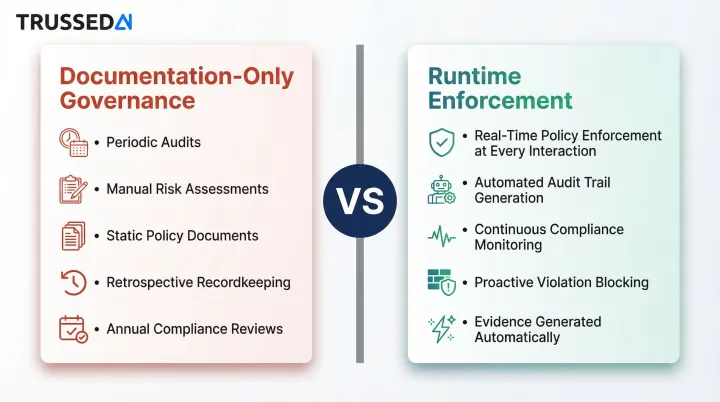
Regulators have sharpened their focus on AI-driven decisions. Upstart's 2024 10-K filing highlights increased regulatory scrutiny on complex credit scoring algorithms, underscoring the need for continuous fair lending testing to prevent disparate impacts, a requirement that documentation-only governance cannot satisfy.
Conclusion
As enterprises accelerate AI deployment into production, governance has to keep pace with deployment, with real-time enforcement, automated evidence, and continuous compliance monitoring built into how AI actually runs. The EU AI Act's enforcement timeline (August 2026 for high-risk systems) and NIST AI RMF adoption across federal agencies make this urgency non-negotiable.
Align platform selection to your most pressing risk:
- Organizations needing runtime control and audit-ready evidence for regulated AI deployments should prioritize platforms built for production enforcement
- Organizations building an initial AI governance program may benefit from documentation-focused tools first, then layer in runtime controls as AI moves to production
- Enterprises already invested in legacy GRC platforms should evaluate whether AI modules provide true runtime enforcement or only extend documentation workflows
For enterprises in regulated industries, Trussed AI's control plane enforces governance at runtime across models, agents, and developer tools, with zero changes to application code. The platform goes live in under four weeks, maintains audit trails automatically, and adds less than 20ms of latency, making compliance a byproduct of operation rather than a separate workstream.
Frequently Asked Questions
What is an AI GRC platform and how is it different from traditional GRC software?
AI GRC platforms govern AI systems specifically, including their outputs, behaviors, and policy compliance at runtime. Traditional GRC platforms were built for business process controls, financial audits, and static IT compliance, and lack the ability to monitor or enforce governance across live AI interactions that produce dynamic, probabilistic outputs.
Do I need a dedicated AI GRC platform if I already have a GRC tool like ServiceNow or MetricStream?
Existing GRC platforms are adding AI governance modules, but these typically handle documentation and risk assessment rather than runtime enforcement. Organizations deploying AI in production, especially in regulated industries, often need a dedicated control layer that enforces policies on every interaction in real time, not just periodic documentation reviews.
What regulatory frameworks do AI GRC platforms support in 2026?
Primary frameworks include the EU AI Act (enforced August 2026), NIST AI RMF, and ISO/IEC 42001. Sector-specific requirements also apply: HIPAA for healthcare AI and Federal Reserve SR 11-7 for financial Solution model risk management.
What features should I prioritize when evaluating an AI GRC platform?
Prioritize runtime policy enforcement (not just documentation), automated audit trail generation, integration with existing AI infrastructure without requiring code changes, continuous compliance monitoring, and support for agentic and multi-model AI workflows, not just single LLM applications.
How does AI governance differ for agentic AI vs. traditional LLM applications?
Agentic AI systems act autonomously, chain multiple tools and models together, and make decisions without a human in the loop. This requires platforms that can enforce policies across multi-step workflows and authorize every tool call before execution, not just filter outputs from individual model calls.
How long does it typically take to deploy an AI GRC platform in a regulated enterprise?
Deployment timelines vary by approach: documentation-focused platforms can be configured in weeks, while runtime control plane solutions like Trussed AI go live in under four weeks using drop-in proxy architecture. Full enterprise rollouts across all AI apps and agents typically require phased implementation over several months.