Introduction
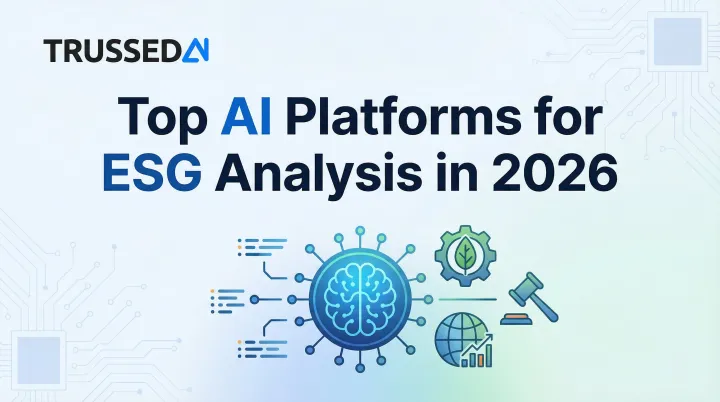
Sustainability teams in 2026 are managing hundreds of ESG data points across overlapping frameworks, with tightening deadlines and rising investor scrutiny. The EU's Corporate Sustainability Reporting Directive (CSRD) now covers thousands of companies, ISSB standards have gained mandatory traction in 21 jurisdictions, and regulatory pressure on ESG claims has intensified, even as the US SEC stepped back from its climate disclosure rule in March 2025.
What once took weeks of manual analysis, including framework gap assessments, peer benchmarking, and disclosure drafting, now runs in hours. AI platforms purpose-built for ESG deliver automated framework mapping, NLP-driven document analysis, and audit-ready outputs at a scale no sustainability team could match manually.
The core challenge isn't just automating reporting. It's ensuring that AI-generated ESG outputs are defensible, auditable, and compliant at scale. As AI systems take on more responsibility for regulated disclosures, the governance of those systems becomes a compliance question in its own right.
Key Takeaways
- AI has become essential infrastructure for ESG analysis, compressing framework gap analyses and peer benchmarking from weeks to hours
- Leading platforms deliver automated framework mapping, NLP document analysis, peer benchmarking, and audit-ready outputs beyond basic data collection
- IBM Envizi, Persefoni, Salesforce Net Zero Cloud, and peers each target distinct enterprise use cases and maturity levels
- ESG platforms handle data and reporting , AI governance infrastructure (policy enforcement, audit trails, security controls) is a separate layer that regulated industries must evaluate before full deployment
Why AI Is Transforming ESG Analysis in 2026
AI for ESG analysis in 2026 means platforms using NLP, machine learning, and generative AI to process unstructured disclosures, automate framework mapping, surface data anomalies, and generate peer comparisons at scale. This goes well beyond what traditional reporting software can do. The ESG reporting software market reflects this shift, projected to grow from $1.3 billion in 2026 to $2.9 billion by 2031 at 17.4% CAGR. Organizations are abandoning manual spreadsheets for AI-driven platforms that produce audit-ready data integrated with financial and operational systems.
Three regulatory shifts are converging in 2026 to make platform selection consequential:
- CSRD enforcement is expanding to large non-NFRD companies for FY2025 reporting, with listed SMEs following for FY2026
- ISSB standards have reached mandatory adoption across 21 jurisdictions as of January 2026
- The EU AI Act entered full applicability in August 2026, adding a compliance layer on top of the AI tools themselves
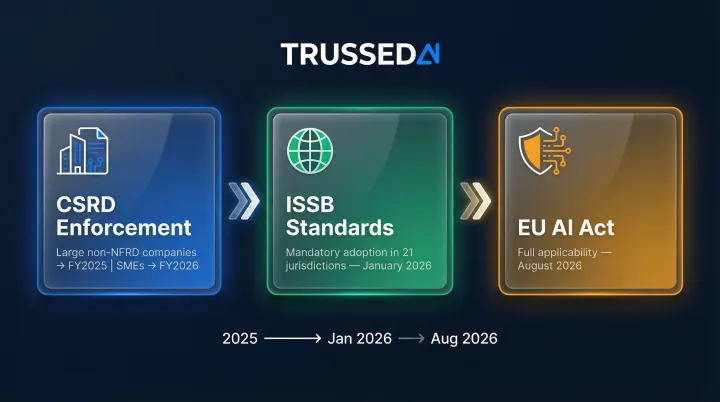
That last point matters more than most organizations realize. The platform you use to analyze ESG data is now itself subject to regulatory scrutiny, making ESG AI platform selection a decision with real legal and operational weight.
What to Look For in an ESG AI Platform
The shortlist for the best AI platforms for environmental, social, and governance analysis has shifted noticeably between 2025 and 2026. Capabilities that were differentiators a year ago, including automated emissions accounting, framework mapping, and GenAI-assisted disclosure drafting, are now table stakes. The platforms separating themselves are the ones that close the loop between ingestion, analysis, assurance, and audit.
When evaluating platforms, six capabilities matter most at enterprise scale:
- Multi-framework coverage: Native support for CSRD/ESRS, ISSB (IFRS S1/S2), GRI, TCFD, SASB, and CDP, with mappings between them
- Audit-ready data lineage: Every reported number traceable to its source system, transformation, and approver
- NLP for unstructured disclosures: Ability to extract material data points from PDFs, supplier responses, and regulatory filings
- Scope 3 and supply chain modeling: Activity-based emissions calculations, supplier engagement workflows, and primary data ingestion
- Peer benchmarking and gap analysis: Automated comparison against industry cohorts and framework requirements
- Assurance workflow support: Controls, attestation trails, and exportable evidence for limited or reasonable assurance engagements
Maturity, integration depth, and governance posture vary widely across vendors. The platforms below represent the categories most enterprises are evaluating in 2026.
The Top AI Platforms for ESG Analysis in 2026
These platforms are grouped by their primary strength, not ranked head-to-head. Selection depends on existing tech stack, regulatory footprint, and ESG program maturity.
IBM Envizi ESG Suite
IBM Envizi is one of the most established platforms for enterprise sustainability data management, with strong roots in environmental performance tracking. It consolidates more than 500 data types into a single system of record and applies AI to automate utility bill ingestion, emissions calculations, and anomaly detection in operational data.
Best fit: Large industrials, real estate portfolios, and asset-heavy enterprises that need granular Scope 1, 2, and 3 tracking tied to operational systems. Envizi's integration with IBM's broader watsonx and Maximo ecosystem makes it a natural choice for organizations already standardized on IBM infrastructure.
Watch outs: Implementation timelines can be lengthy, and unlocking the most advanced analytics often requires the wider IBM stack rather than Envizi alone.
Persefoni
Persefoni positions itself as a climate management and accounting platform (CMAP), with deep specialization in carbon accounting aligned to GHG Protocol, PCAF, and ISSB standards. Its AI co-pilot accelerates emissions calculations, scenario modeling, and disclosure drafting, with controls designed to support reasonable assurance.
Best fit: Financial institutions managing financed emissions, and enterprises whose ESG reporting is dominated by climate metrics. Persefoni's audit-grade lineage is a strong fit for organizations preparing for CSRD and California's SB 253/261 disclosure requirements.
Watch outs: The platform is climate-first; broader social and governance metrics typically need to be handled in adjacent tools.
Salesforce Net Zero Cloud
Net Zero Cloud brings ESG data into the same CRM-native environment that many enterprises already use for customer and operational data. It leverages Einstein AI for emissions forecasting, scenario analysis, and disclosure assistance, and integrates with Slack, Tableau, and Data Cloud for distribution and visualization.
Best fit: Salesforce-standardized enterprises that want ESG reporting embedded in existing workflows rather than as a siloed system. Particularly strong for organizations whose sustainability narrative is tightly coupled to customer, product, and supply chain data already in Salesforce.
Watch outs: Value scales with broader Salesforce adoption; standalone deployments tend to underutilize the platform's strengths.
Workiva
Workiva's strength is connected reporting,linking ESG data to the same controlled environment that produces financial filings. Its generative AI assistant helps draft disclosures, identify framework gaps, and maintain consistency across CSRD, ISSB, and SEC-style reports.
Best fit: Public companies and CSRD-in-scope organizations that need ESG and financial reporting under unified controls. Workiva is frequently the choice when the CFO and Chief Sustainability Officer need to share a single source of truth.
Watch outs: Workiva is strongest at the reporting layer; primary data collection and Scope 3 modeling often require complementary tools.
Microsoft Sustainability Manager
Part of the Microsoft Cloud for Sustainability, Sustainability Manager ingests data across Microsoft 365, Azure, Dynamics, and Fabric, applying Copilot-powered analytics to emissions calculation, water, and waste tracking. It is increasingly bundled with Microsoft's broader Fabric data platform.
Best fit: Microsoft-standardized enterprises with strong Azure and Fabric footprints, particularly those wanting ESG metrics adjacent to operational data lakes.
Watch outs: Framework-specific reporting depth has historically lagged specialist platforms; many customers pair it with a dedicated reporting tool.
Watershed
Watershed has built a reputation for high-quality emissions data and assurance-ready outputs, with significant adoption among consumer brands, financial Solution, and tech companies. Its AI tooling focuses on supplier data extraction, methodology automation, and CSRD/ISSB-aligned disclosure preparation.
Best fit: Enterprises where assurance quality and supplier-level Scope 3 data are top priorities, and where speed-to-disclosure under tight regulatory deadlines is critical.
Watch outs: Pricing reflects its enterprise positioning; smaller organizations may find the cost-to-value ratio harder to justify.
Sphera
Sphera combines ESG, EHS, and operational risk in a single suite, with strong product lifecycle and supply chain risk capabilities. AI is applied to supplier risk scoring, regulatory change monitoring, and product compliance tracking.
Best fit: Manufacturers, chemicals, and energy companies that need ESG analysis tied to operational risk, hazardous materials, and product stewardship.
Watch outs: The breadth of the suite means buying decisions are rarely ESG-only; expect cross-functional procurement involvement.
Diligent ESG
Diligent's ESG module sits inside its broader GRC platform, making it a natural fit for boards, audit committees, and risk functions already using Diligent for governance workflows. AI features support disclosure benchmarking, materiality assessment, and policy gap analysis.
Best fit: Organizations where ESG oversight is governed primarily at the board and risk-committee level, and where ESG reporting needs to be tightly integrated with governance and audit processes.
Watch outs: Operational data ingestion (especially Scope 1 and 2 emissions) is less mature than dedicated environmental platforms.
The AI Governance Layer ESG Platforms Don't Cover
Even the best ESG AI platforms solve a specific problem: turning sustainability data into framework-aligned disclosures. They do not solve the broader question of how the underlying AI systems themselves are governed, monitored, and audited.
That distinction matters in 2026. With the EU AI Act now fully applicable, AI systems used to produce regulated disclosures sit inside a compliance regime of their own. ESG platforms generate outputs; AI governance infrastructure ensures those outputs are produced under enforceable policy, with traceable inputs and verifiable controls.
Three gaps consistently appear when organizations rely on ESG platforms alone:
- Policy enforcement at runtime: Most ESG platforms provide role-based access and approval workflows, but not real-time policy enforcement on prompts, model selection, or data flowing into and out of generative AI features
- Cross-system audit trails: ESG audit logs cover the reporting platform, not the underlying model interactions, prompt history, or third-party AI Solution that contributed to a given output
- Shadow AI in sustainability workflows: Analysts increasingly use general-purpose AI tools to draft disclosures, summarize supplier responses, and analyze peer reports,often outside any sanctioned ESG platform
For regulated industries, these gaps translate directly into regulatory exposure. CSRD assurance providers, EU AI Act conformity assessors, and internal audit teams increasingly want to see evidence of how AI systems were used, what data they processed, and what controls were in force at the time.
This is where a dedicated AI control plane complements, rather than competes with, an ESG platform. Trussed AI sits between applications (including ESG tools that embed generative AI features) and the underlying models, enforcing policy in real time, generating audit-ready records of every AI interaction, and providing visibility into AI usage across developer environments, agents, and SaaS tools.
Deployment is non-disruptive: SDKs for Python, TypeScript, and Go, a REST API, and integrations through AWS and Google Cloud allow Trussed AI to slot into existing ESG and reporting workflows without changes to application code. For enterprises whose CSRD, ISSB, or sector-specific disclosures are increasingly AI-assisted, that runtime governance layer is becoming as important as the ESG platform itself.
Conclusion
The market for the best AI platforms for environmental, social, and governance analysis has matured rapidly from 2025 into 2026. IBM Envizi, Persefoni, Salesforce Net Zero Cloud, Workiva, Microsoft Sustainability Manager, Watershed, Sphera, and Diligent each address a different slice of the ESG reporting and analysis problem, and most enterprises end up combining two or more to cover their full footprint.
The right platform choice is now driven by three questions: which frameworks must you report against, how does ESG data need to integrate with the rest of your operational and financial stack, and how will you prove that the AI components inside your reporting pipeline meet the standards regulators and assurance providers now expect.
That last question is where many sustainability programs are still under-invested. ESG platforms produce disclosures; AI governance produces defensibility. Both are needed when the systems generating regulated outputs are themselves subject to regulation.
If your organization is building or scaling AI-assisted ESG reporting, Trussed AI's enterprise control plane provides the runtime governance layer that ensures every AI-generated disclosure is policy-compliant, fully logged, and ready for assurance,long before the auditors arrive.
Frequently Asked Questions
What is an AI platform for ESG analysis?
An AI platform for ESG analysis uses NLP, machine learning, and generative AI to ingest sustainability data, map it to reporting frameworks like CSRD and ISSB, surface anomalies, generate peer benchmarks, and draft audit-ready disclosures. It goes beyond traditional ESG reporting software by automating tasks that previously required manual analyst work.
Which AI platform is best for CSRD reporting?
No single platform is universally best. Workiva is strong when ESG must align with financial reporting under unified controls; Persefoni excels when climate metrics dominate; IBM Envizi suits asset-heavy enterprises; and Watershed is often chosen for assurance-grade Scope 3 data. Most CSRD-in-scope enterprises end up combining a primary ESG platform with complementary tools.
How is AI changing ESG analysis in 2026?
AI compresses framework gap analyses and peer benchmarking from weeks to hours, automates emissions calculations, extracts material data points from unstructured documents, and drafts disclosures aligned to multiple frameworks simultaneously. The shift from manual spreadsheets to AI-driven platforms is now the default direction of travel for enterprise sustainability teams.
Are ESG AI platforms regulated under the EU AI Act?
It depends on the use case. AI systems that materially influence regulated disclosures, ratings, or decisions can fall within the scope of the EU AI Act's transparency and risk-management requirements. With the Act fully applicable in August 2026, organizations should evaluate ESG platform AI features against the same governance standards as other regulated AI systems.
Do ESG platforms include AI governance capabilities?
Most ESG platforms include role-based access, approval workflows, and audit logs for the reporting layer,but not full AI governance. Runtime policy enforcement, prompt-level audit trails, model-routing controls, and shadow AI discovery typically require a dedicated AI governance control plane that operates across applications, not just inside a single platform.
What is the difference between ESG reporting software and AI governance for ESG?
ESG reporting software focuses on collecting, analyzing, and disclosing sustainability data against frameworks. AI governance for ESG focuses on how the AI components inside that pipeline are controlled,what data they can access, what policies apply to their outputs, and how their behavior is logged for audit. The two are complementary: one produces the disclosure, the other proves the disclosure was produced under enforceable controls.