Introduction
Enterprise AI teams face a critical challenge: AI governance frameworks have proliferated faster than most organizations can evaluate them. ISO 42001 and NIST AI RMF dominate boardroom and compliance conversations, yet choosing between, or combining, these two standards has real consequences for regulatory readiness, audit credibility, and day-to-day AI operations.
Those consequences hit hardest in regulated industries like healthcare, financial Solution, and insurance. 78% of organizations now use AI, while U.S. federal agencies introduced 59 AI-related regulations in 2024, more than double the previous year. Globally, legislative mentions of AI rose 21.3% across 75 countries. This guide breaks down what each framework requires, where they diverge, and how to decide which approach fits your organization's compliance posture.
Key Takeaways
- ISO 42001 is a certifiable international standard (10 clauses, 38 controls) requiring third-party audit and delivering global recognition
- NIST AI RMF is a voluntary U.S.-originated framework (4 functions: Govern, Map, Measure, Manage), free to download, self-attested, with no formal certification
- ISO 42001 fits organizations needing structured governance and cross-border credibility; NIST AI RMF suits teams prioritizing flexibility and U.S.-market alignment
- The two are complementary. Most organizations start with NIST AI RMF, then pursue ISO 42001 certification as their AI program scales
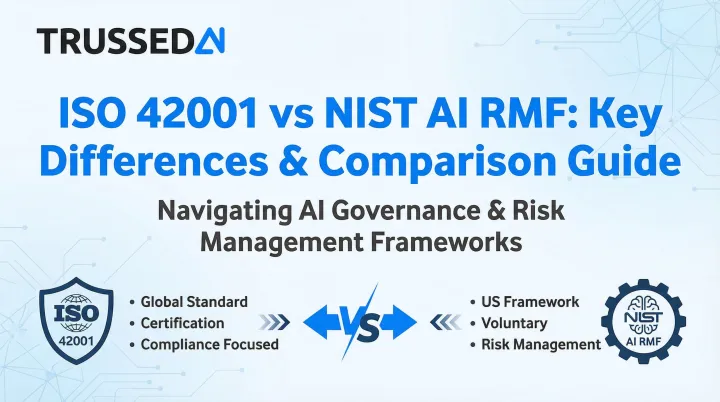
ISO 42001 vs. NIST AI RMF: Quick Comparison
Both frameworks address AI risk, but they differ significantly in structure, certification requirements, and implementation scope. Here's how they compare at a glance:
| Feature | ISO/IEC 42001:2023 | NIST AI RMF 1.0 |
|---|---|---|
| Nature | Certifiable international standard | Voluntary risk management framework |
| Governing Body | International Organization for Standardization (ISO) | National Institute of Standards and Technology (NIST) |
| Geographic Scope | Global | U.S.-centric with international influence |
| Structure | 10 clauses, 38 Annex A controls | 4 functions, 72 subcategories |
| Certification | Third-party audit, 3-year cycle | Self-attestation only |
| Cost to Access | CHF 225 plus audit fees ($15,000–$200,000+) | Free to download |
| Implementation Timeline | 9–18 months | 6–9 months |
| Primary Focus | AI management system + organizational governance | Operational risk identification + trustworthiness |
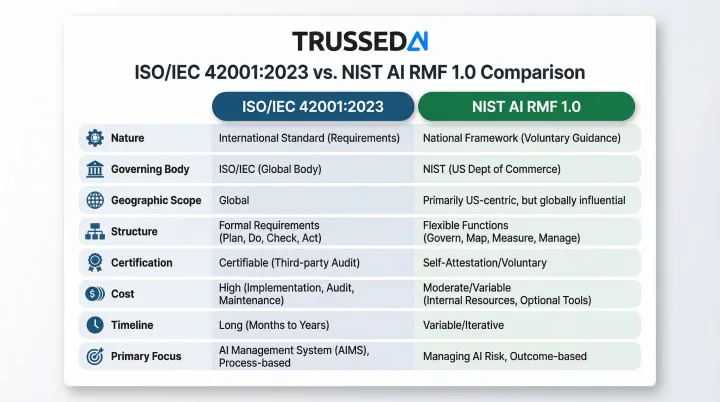
Neither framework is legally mandatory as of 2025. The right choice depends on whether your organization needs externally verifiable certification, operational risk tooling, or both.
What is ISO 42001?
ISO/IEC 42001:2023 is the first international standard specifically for AI management systems, developed by the International Organization for Standardization. It helps organizations that develop, deploy, or use AI build a structured, auditable system for managing AI responsibly across its full lifecycle.
Structural Backbone: 10 Clauses and 38 Controls
ISO 42001 follows the ISO Harmonized Structure, meaning its 10-clause framework aligns with existing management systems like ISO 9001 (Quality) and other information security standards. The standard covers:
- Leadership commitment and AI policy
- Risk assessment and treatment
- Data governance and lifecycle controls
- Transparency and accountability
- Continual improvement processes
Annex A provides 38 specific controls addressing AI-specific risks including bias, explainability, and ethical use. Organizations select applicable controls based on their AI use cases and risk profile.
Certification: The Key Differentiator
ISO 42001 is certifiable via accredited third-party audit, operating on a 3-year certification cycle with annual surveillance audits. This external validation matters for:
- Enterprise procurement: Require suppliers to demonstrate third-party-validated AI governance
- Regulated industries: Healthcare, finance, and insurance increasingly treat formal AI governance as a procurement requirement
- Global operations: A single internationally recognized certification satisfies multiple jurisdictions at once
- Customer trust: Third-party validation carries more weight than self-attested governance claims
Core Benefits
Certification delivers operational impact beyond the audit credential itself:
- Standardized processes reduce governance inconsistency across teams
- Clear accountability structures eliminate ambiguity in AI decision-making
- Audit-ready documentation generated through systematic controls
- Direct integration with existing ISO management systems without restructuring what's already in place
Use Cases of ISO 42001
ISO 42001 delivers maximum value in specific organizational contexts:
Global enterprises operating across multiple jurisdictions benefit from a single internationally recognized certification, one credential that satisfies diverse regulatory expectations without running separate governance programs per region.
Regulated industries such as healthcare, finance, and insurance face growing pressure to treat AI governance as a procurement requirement, not a checkbox. KPMG Australia became the first organization globally to achieve ISO 42001 certification, applying it to internal AI tools to demonstrate governance rigor to audit clients.
Organizations with existing ISO systems get a meaningful implementation shortcut. Companies already holding ISO management certifications can reuse established audit processes and structural controls, typically cutting ISO 42001 adoption timelines by a third or more.
What is NIST AI RMF?
The NIST AI Risk Management Framework (AI RMF 1.0), released January 2023 by the U.S. National Institute of Standards and Technology, is a voluntary framework developed through public-private collaboration. Its purpose: help organizations manage AI system risks throughout their lifecycle, with focus on building trustworthy, reliable, and ethical AI.
Four Core Functions: Govern, Map, Measure, Manage
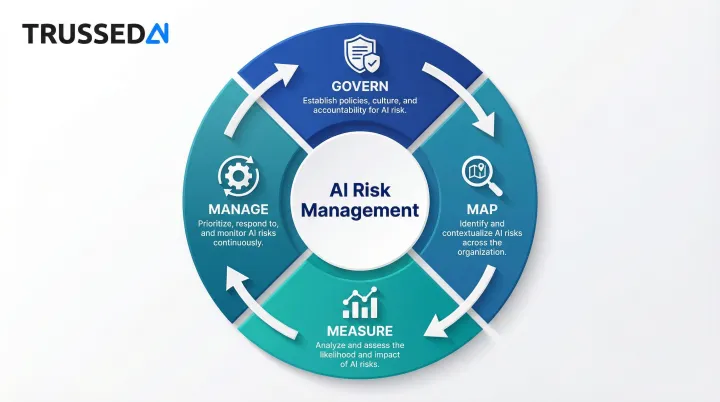
The framework structures AI risk management through four operational functions encompassing 72 subcategories:
Govern: Establish policies, accountability structures, and organizational culture for AI risk management. This function creates the foundation for all other activities.
Map: Identify context, stakeholders, and risk categories for each AI system. Mapping clarifies what risks exist and where they originate.
Measure: Analyze and quantify AI risks using qualitative and quantitative methods. Measurement provides the data needed for informed decisions.
Manage: Prioritize and respond to identified risks through mitigation, transfer, acceptance, or avoidance strategies.
Flexibility Advantage
Unlike ISO 42001's prescriptive management system, NIST AI RMF is deliberately modular and sector-agnostic. Organizations can:
- Adopt all four functions or start with one
- Tailor controls to their specific risk tolerance
- Scale governance as AI programs mature
- Integrate with existing compliance frameworks (HIPAA, NIST AI RMF)
That modularity makes it a practical starting point for teams that aren't ready for full management system certification.
Self-Attestation Model
NIST AI RMF has no formal certification mechanism. Organizations self-assess against the framework and may optionally engage external assessors for credibility. The framework is free to download, making it accessible without licensing fees or certification costs.
Use Cases of NIST AI RMF
NIST AI RMF fits specific organizational contexts best:
- U.S.-focused companies and federal-aligned organizations benefit from mirroring the governance approach the Office of Management and Budget encourages across agencies
- Technology startups and R&D teams can implement risk controls incrementally without committing to full management system certification
- Early-stage governance programs use it as a risk-first lens alongside other compliance efforts. The Financial Services AI Risk Management Framework (FS AI RMF), for example, adapted NIST's structure into 230 sector-specific control objectives
Key Differences Between ISO 42001 and NIST AI RMF
Certification vs. Self-Attestation
This is the most operationally significant difference. ISO 42001's third-party certification creates a verifiable, externally recognized credential, valuable in enterprise sales, regulated industry procurement, and cross-border partnerships. When a vendor claims ISO 42001 certification, buyers can verify it through accreditation registries.
NIST AI RMF's self-attestation offers speed and flexibility but lacks the same external credibility signal. Organizations can claim NIST AI RMF alignment without independent verification, making it harder for stakeholders to assess governance maturity.
If your stakeholders demand proof of governance, whether regulators, enterprise buyers, or board members, certification wins. If you need operational risk controls quickly without external validation overhead, self-attestation is the faster path.
Management System vs. Risk Framework
ISO 42001 installs a comprehensive management system, governing entire organizational AI operations through:
- Defined processes and procedures
- Clear roles and responsibilities
- Documentation requirements
- Continual improvement cycles
NIST AI RMF is a risk identification and mitigation framework. It tells you how to think about and respond to AI risk but doesn't prescribe the full organizational apparatus for managing AI governance.
ISO 42001 embeds governance deeply into organizational operations, requiring systematic changes to how teams work. NIST AI RMF can be applied more surgically to specific AI systems without requiring enterprise-wide governance transformation.
Structure and Prescriptiveness
ISO 42001's 38 Annex A controls provide explicit, auditable requirements, with less room for interpretation but more consistency across teams. Controls specify what organizations must do (e.g., "establish procedures for AI system transparency"), making audit preparation straightforward.
NIST AI RMF's 72 subcategories across four functions are intentionally non-prescriptive, giving organizations flexibility to interpret and apply controls based on context. Subcategories describe outcomes (e.g., "AI system performance is monitored") without mandating specific implementation approaches.
The practical tradeoff comes down to consistency vs. adaptability: ISO 42001 ensures uniform governance across global operations; NIST AI RMF allows customization for diverse AI use cases.
Geographic and Regulatory Alignment
ISO 42001 is internationally recognized and increasingly referenced by global regulators. However, it does not yet provide "presumption of conformity" under the EU AI Act. That designation awaits harmonized European standard publication expected in late 2025 or 2026.
NIST AI RMF originated in U.S. federal context but is referenced globally, particularly in technology and defense sectors. Official crosswalk documents map NIST AI RMF to ISO 42001, facilitating integration.
Organizations operating primarily in Europe or globally should prioritize ISO 42001 for broader recognition. U.S.-focused companies benefit from NIST AI RMF's closer alignment with federal expectations.
Implementation Cost and Timeline
ISO 42001 certification involves significant financial commitment:
| Organization Size | AI Systems in Scope | Estimated Total Cost |
|---|---|---|
| Small (up to 100 staff) | 1-3 systems | $15,000–$40,000 |
| Mid-size (100-500 staff) | 3-8 systems | $40,000–$90,000 |
| Large (500+ staff) | 8+ systems | $90,000–$200,000+ |
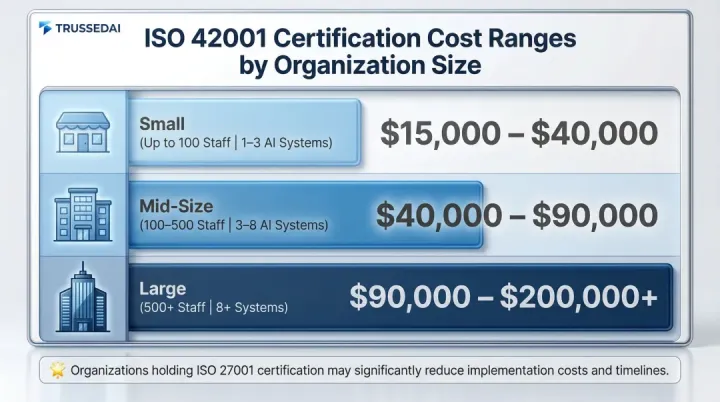
Costs include the standard purchase, implementation effort, and external audit fees. Organizations already holding ISO management certifications can reduce these costs noticeably, as management system familiarity and existing audit infrastructure carry over directly.
By contrast, NIST AI RMF is free to access and can be implemented within 6–9 months. That makes it the more accessible starting point for resource-constrained teams or organizations needing to demonstrate AI governance quickly.
Which Framework Is Right for Your Organization?
Decision Criteria
Choose ISO 42001 if you:
- Operate globally and need internationally recognized certification
- Compete in regulated industries where third-party credentials are procurement expectations
- Already maintain ISO management systems (ISO 9001 or similar)
- Require structured, auditable governance for board and stakeholder confidence
Choose NIST AI RMF if you:
- Focus primarily on U.S. markets or federal alignment
- Are in early stages of AI governance maturity
- Operate in fast-moving innovation environments requiring flexibility
- Need a risk management lens integrating with existing frameworks (HIPAA, NIST AI RMF)
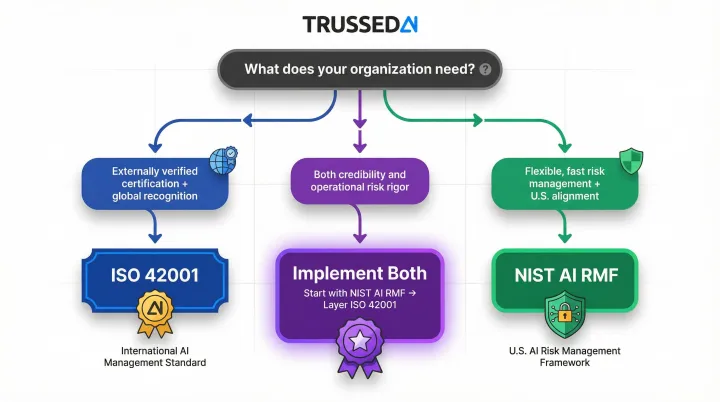
Consider both if you:
- Need global credibility and operational risk rigor
- Plan to start with NIST AI RMF for rapid implementation, then layer ISO 42001 for certification
- Serve diverse stakeholder groups with varying governance expectations
The Operationalization Gap
Whichever framework you select, a shared limitation applies: neither solves the challenge of translating static governance policies into real-time enforcement across production AI systems.
Both ISO 42001 and NIST AI RMF define policies and risk categories, but they don't enforce them across AI systems, agents, and workflows as decisions happen. For enterprises deploying LLMs or agentic AI, that gap is where compliance exposure lives.
Trussed AI's control plane addresses this directly: governance policies from either framework become live controls, with continuous compliance monitoring and audit evidence generated automatically. Rather than reconstructing compliance weeks after AI decisions, Trussed generates audit-ready evidence continuously as it enforces policies. In early enterprise deployments, organizations reported a 50% reduction in manual governance workload and reached operational workflows in approximately 4 weeks.
Real-World Scenario
Consider a healthcare organization deploying AI-powered clinical documentation assistants. They start with NIST AI RMF to identify risks, including bias in clinical recommendations, patient data exposure, and model reliability, and implement initial controls within 6 months. As the AI system scales across hospital networks, enterprise buyers require third-party governance validation.
The organization layers ISO 42001 certification onto their existing NIST AI RMF foundation, using official crosswalk documents to map controls. Their governance infrastructure (built on a platform like Trussed AI) enforces policies from both frameworks in real time, generating continuous audit evidence that satisfies ISO 42001 auditors and NIST AI RMF self-assessment requirements.
The result: operational risk management from NIST AI RMF, external credibility from ISO 42001, and a compliance posture that holds as healthcare AI regulations tighten.
Conclusion
ISO 42001 and NIST AI RMF are not competitors. They address different organizational needs and work together effectively. ISO 42001 delivers structured, certifiable, globally recognized AI governance; NIST AI RMF offers flexible, risk-first approaches easier to adopt and adapt.
The right choice depends on where your organization operates, what stakeholders expect, and how mature your AI governance program is. Many regulated enterprises ultimately integrate both frameworks, starting with NIST AI RMF for rapid risk management and layering ISO 42001 for certification credibility.
Adopting a framework is only the starting point. Enterprises in insurance, healthcare, and financial Solution need that framework enforced at runtime, in every model call, agent interaction, and automated workflow. The next step is infrastructure that applies policies continuously, generates audit-ready evidence automatically, and flags violations before they become regulatory exposure. That's where governance moves from documentation to practice.
Frequently Asked Questions
How does the NIST AI Risk Management Framework compare to other frameworks like ISO 42001 or CIS?
NIST AI RMF focuses specifically on AI risk management across trustworthiness characteristics (fairness, transparency, safety). ISO 42001 provides a certifiable AI management system. CIS Controls target cybersecurity defenses. NIST AI RMF complements both by providing AI-specific risk lenses.
What are the alternatives to the NIST AI Risk Management Framework (e.g., ISO 42001)?
Key alternatives include ISO 42001 (certifiable AI management system), the EU AI Act (regulatory framework with legal requirements), OECD AI Principles (international ethical guidelines), and emerging national frameworks. They differ most on enforceability: ISO 42001 is voluntary and certification-based, while the EU AI Act carries legal mandates with penalties for non-compliance.
What are the 4 types of AI risk?
The four commonly recognized AI risk categories are: technical risks (bias, errors, model drift), operational risks (system failures, misuse), ethical and societal risks (discrimination, privacy violations), and security risks (adversarial attacks, data poisoning). Understanding which category your AI system is most exposed to helps determine whether a governance-first (ISO 42001) or risk-management-first (NIST AI RMF) approach fits better.
Can organizations implement ISO 42001 and NIST AI RMF at the same time?
Yes, the frameworks are highly complementary with significant overlap. Many organizations use NIST AI RMF as a starting point for operational risk management and adopt ISO 42001 for certification credibility. Official crosswalk documents map controls between the two, so teams implementing both can share evidence and avoid redundant work.
Is ISO 42001 certification mandatory?
No, ISO 42001 is voluntary as of 2025. That said, it's increasingly expected in enterprise procurement, regulated industry contracts, and EU AI Act compliance discussions, making certification a competitive differentiator even without a legal mandate.