Introduction
Enterprises are deploying AI faster than their governance can keep up,and when governance fails, the costs aren't just operational. They're regulatory, reputational, and financial.
GDPR fines for automated decision-making failures now reach €20 million, while the EU AI Act imposes penalties up to €35 million or 7% of global annual turnover for prohibited AI practices. Manual compliance processes consume 8-10 hours per week for global systemically important banks, and organizations lose an average of $5.87 million from a single non-compliance event.
AI governance consulting has emerged as a distinct discipline , separate from general AI consulting in both scope and complexity. It focuses on policy framework design, risk classification, regulatory compliance mapping, audit trail architecture, and ongoing monitoring , not model building or workflow automation. The pricing reflects this: governance engagements carry a 20-40% premium over standard AI consulting rates due to specialized compliance knowledge and the higher stakes of violations.
This guide breaks down real cost ranges, governance-specific ROI metrics for building a business case, and a practical selection framework built for regulated industries.
Key Takeaways
- AI governance consulting costs more than general AI consulting due to regulatory complexity,project engagements range from $40,000–$200,000+, with retainers running $8,000–$25,000/month
- ROI comes from avoided regulatory fines, lower audit preparation costs, and faster incident response,not productivity gains
- Hidden costs,policy refresh cycles, ongoing monitoring, and model re-auditing,often exceed initial engagement fees within 12 months
- The most effective governance programs combine consulting expertise with runtime enforcement,advisory alone doesn't prevent violations in production
What AI Governance Consulting Actually Entails
AI governance consulting differs from general AI strategy or implementation consulting. It focuses on policy framework design, risk classification, regulatory compliance mapping (EU AI Act, NIST AI RMF, HIPAA), audit trail architecture, and ongoing monitoring , not model building or workflow automation.
Gartner defines AI Trust, Risk and Security Management (AI TRiSM) as ensuring governance, trustworthiness, fairness, reliability, and data protection through specific technical capabilities like runtime inspection and offline governance functions.
Three Common Engagement Types
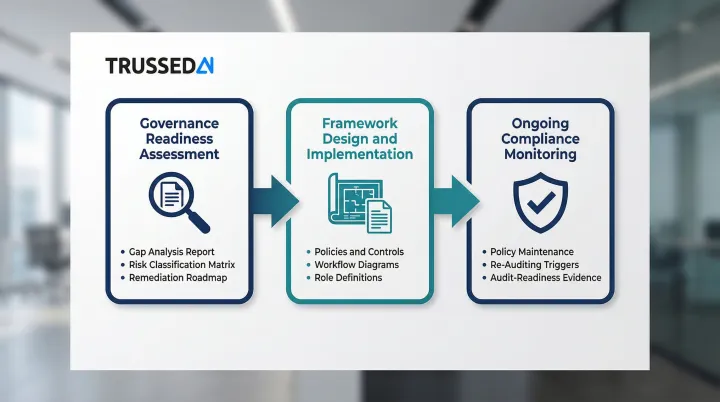
- Governance Readiness Assessment - Audits current AI deployments against regulatory requirements. Delivers a gap analysis report, risk classification matrix, and prioritized remediation roadmap.
- Framework Design & Implementation - Builds policies, controls, and documentation from the ground up. Deliverables include workflow diagrams, role definitions, and training materials for cross-functional teams.
- Ongoing Compliance Monitoring - Provides continuous oversight as models and regulations evolve. One-time assessments decay in value fast; this engagement handles policy maintenance, re-auditing triggers, and audit-readiness evidence generation.
The Regulated Industry Premium
Regulated industries face a governance premium of roughly 20-40% over standard AI consulting rates. The breakdown by industry:
| Industry | Premium Range | Key Drivers |
|---|---|---|
| Healthcare | 20–25% | HIPAA, clinical AI risk, audit requirements |
| Financial Services | 15–20% | Algorithmic fairness, fraud detection frameworks |
The stakes justify the premium. High-risk AI systems under the EU AI Act , including credit scoring, life/health insurance pricing, and healthcare triage , require strict pre-deployment conformity assessments, quality management systems, and continuous post-market monitoring.
The gap between intent and execution is striking: a 2026 Healthcare Cybersecurity Benchmarking Study found that only 12% of U.S. hospitals have formal AI governance frameworks in place, despite 70% having established AI governance committees.
AI Governance Consulting Cost Breakdown
AI consulting costs vary drastically based on firm structure, brand premium, and delivery model. Big 4 and MBB firms charge between $300 and $1,000+ per hour for AI governance consulting, often staffing junior analysts for execution. Boutique AI consultancies charge $150–$300 per hour with senior practitioner delivery, while independent experts charge $150–$350 per hour.
Market-rate ranges by engagement type:
- Governance readiness assessments: $15,000–$50,000
- Framework design and implementation: $40,000–$150,000+
- Enterprise-wide AI governance programs: $150,000–$500,000+
- Ongoing retainers: $8,000–$25,000/month
For a Fortune 500 financial Solution firm, a comprehensive program including Center of Excellence design, governance frameworks, and ROI modeling typically ranges from $400,000 to $875,000+ in consulting fees.
How you structure the engagement affects both total cost and long-term value.
Pricing Models Compared
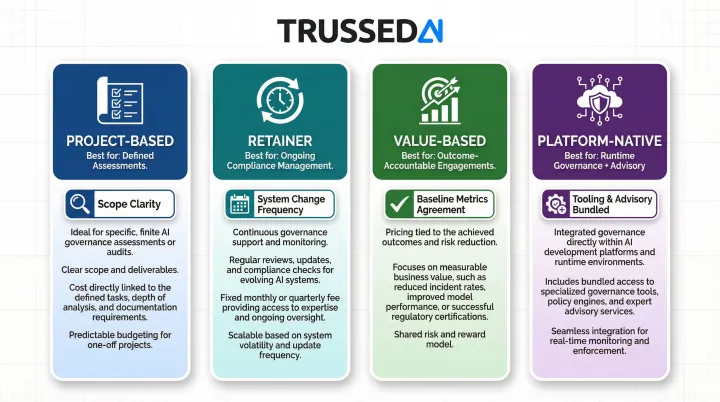
Project-Based Pricing works best for defined deliverables like a regulatory gap assessment or governance framework build. This model protects both parties when scope is clearly defined , specify systems audited, frameworks covered, and revision cycles included.
Budget certainty is the main draw. The tradeoff: project-based engagements don't account for the ongoing nature of governance as AI systems and regulations evolve.
Retainer-Based Pricing addresses the reality that AI systems and regulations change continuously, making one-time assessments lose relevance fast. A governance retainer should cover:
- Policy maintenance as models are updated
- Re-auditing triggers when systems change significantly
- Incident response support when violations occur
- Audit-readiness evidence generation for regulatory examinations
This model is especially critical for enterprises running agentic AI, where autonomous systems take actions across multiple tools and databases that require continuous oversight.
Value-Based Pricing ties consultant fees to measurable governance outcomes , for example, percentage of compliance violations reduced or audit preparation time cut. This model is less common but gaining traction as procurement teams push for measurable governance outcomes. Value-based structures require clear baseline metrics and agreement on measurement methodology before the engagement begins.
Big 4 and large strategy firms charge the highest rates but bring regulatory relationship depth and board-level credibility for M&A due diligence. Boutique AI governance specialists offer more hands-on implementation at lower rates with direct senior practitioner access. Platform-native governance providers combine advisory with runtime tooling , a newer model where fees cover both strategy and execution, shifting the focus from documents to measurable outcomes.
| Model | Best For | Typical Cost Driver |
|---|---|---|
| Project-based | Defined assessments or framework builds | Scope clarity |
| Retainer | Ongoing policy and compliance management | System change frequency |
| Value-based | Outcome-accountable engagements | Baseline metrics agreement |
| Platform-native | Runtime governance + advisory combined | Tooling + advisory bundled |
How to Calculate ROI on AI Governance Consulting
Governance ROI is primarily a risk-avoidance calculation, not a productivity calculation. The two primary financial inputs are: (1) the probability-weighted cost of regulatory fines or enforcement actions without governance controls in place; and (2) the annual cost of manual compliance processes being replaced or accelerated.
Regulatory Fine Exposure
The EU AI Act imposes fines up to €35 million or 7% of total worldwide annual turnover for prohibited AI practices, with penalties reaching €15 million or 3% of turnover for non-compliance with high-risk obligations.
GDPR violations carry penalties up to €20 million or 4% of worldwide annual turnover. The French DPA fined Clearview AI €20 million for unlawful facial recognition processing as a direct example of that ceiling being reached.
HIPAA civil monetary penalties range from $145 to $2,190,294 per violation, with HHS OCR imposing a $1.5 million penalty against Warby Parker for a credential stuffing breach. The FTC banned Rite Aid from using AI facial recognition for five years due to lack of reasonable safeguards, demonstrating that penalties extend beyond financial fines to operational restrictions.
Sample ROI Calculation Framework
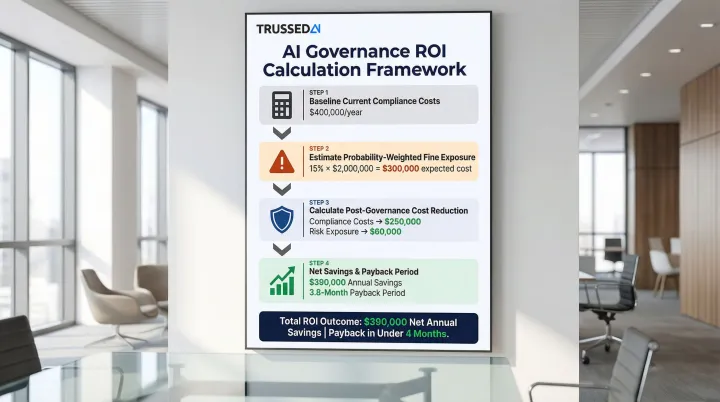
Step 1: Baseline Current Annual Compliance Costs
Calculate the total annual cost of compliance-related activities:
- Audit preparation hours × loaded labor rate
- External legal review fees
- Incident remediation costs
- Manual policy enforcement and monitoring
For a mid-market financial Solution firm with 500 employees, this might total $400,000 annually: 2,000 hours of compliance team time at $150/hour ($300,000) plus $100,000 in external legal and audit fees.
Step 2: Estimate Probability-Weighted Fine Exposure
Assess your current risk exposure:
- Probability of regulatory violation (e.g., 15% annually based on current controls)
- Average fine amount for your industry and violation type (e.g., $2 million)
- Probability-weighted exposure: 15% × $2M = $300,000 annual expected cost
Step 3: Calculate Post-Governance Costs and Risk Reduction
Estimate what governance consulting reduces costs to:
- Annual compliance costs reduced to $250,000 (automated policy enforcement, streamlined audit preparation)
- Violation probability reduced to 3% (structured controls, continuous monitoring)
- Probability-weighted exposure reduced to: 3% × $2M = $60,000
Step 4: Calculate Net Annual Savings and Payback Period
- Compliance cost savings: $400,000 - $250,000 = $150,000
- Risk reduction savings: $300,000 - $60,000 = $240,000
- Total annual savings: $390,000
- Governance consulting investment: $125,000 (framework implementation + 6-month retainer)
- Payback period: $125,000 ÷ $390,000 = 3.8 months
Operational ROI Layer
Governance consulting that produces structured audit trails, automated policy enforcement, and documented risk classifications directly reduces the time internal teams spend on compliance evidence gathering. 62% of compliance teams spend between 1 and 7 hours per week tracking regulatory developments, while 48% of global systemically important banks spend 8-10 hours per week.
A Forrester Total Economic Impact study of the OneTrust platform quantified what structured governance tooling delivers in practice:
- 227% ROI over three years with a seven-month payback period
- 75% improvement in privacy team productivity through automated workflows
- 75% reduction in the risk of compliance failure and regulatory fallout
Governance Debt Risk Multiplier
Organizations that skip governance now face compounding costs later,retroactive audits, remediation of non-compliant AI deployments already in production, and change management overhead. The longer governance is deferred, the more AI systems accumulate in production without controls, and the higher the remediation bill grows.
Capital One incurred $72 million in incremental expenses related to the remediation of its 2019 cybersecurity incident. Remediation costs often exceed the initial compliance investment by 5-10x when organizations retrofit governance rather than build it in from the start.
Runtime Governance Platform ROI
Consulting advisory defines the governance strategy; a runtime control plane enforces it continuously in production. Those are two distinct ROI layers, and both matter.
Enterprises pairing advisory with a runtime governance platform like Trussed AI's report measurable ongoing outcomes: 50% reduction in manual governance workload, less than 1% compliance violations, and complete audit trails generated automatically as a byproduct of every governed interaction,without additional manual effort from compliance teams.
Hidden Costs in AI Governance Engagements
Three Most Common Hidden Cost Categories
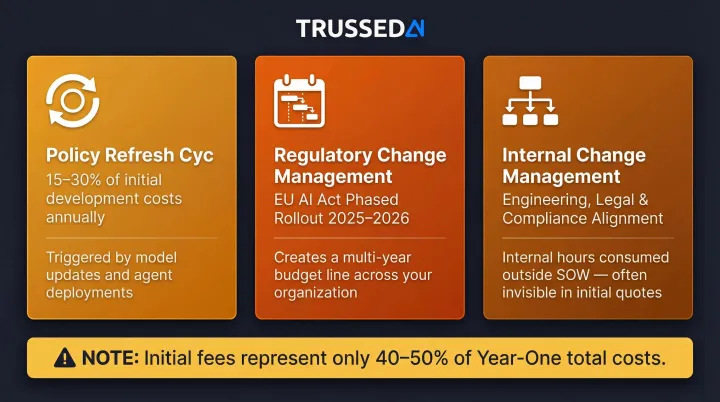
Most AI governance engagements carry three recurring cost categories that rarely appear in a consultant's proposal:
- Policy refresh cycles: Governance frameworks require re-validation each time underlying AI systems change , model updates, retraining runs, and new agent deployments all trigger review. Post-deployment maintenance and monitoring typically run 15-30% of initial development costs annually, covering bug fixes, retraining, and security patches.
- Regulatory change management: The EU AI Act's phased rollout , prohibitions in February 2025, general-purpose AI rules in August 2025, high-risk system rules in August 2026 , means policy updates and system audits are a multi-year budget line, not a one-time project.
- Internal change management: Aligning engineering, legal, and compliance teams on new governance processes often requires facilitation outside the consulting statement of work. Training, stakeholder alignment, and workflow redesign consume internal hours that never appear in the external fee estimate.
Total Cost of Ownership Gap
These three categories compound quickly. Initial consulting fees typically represent only 40-50% of year-one governance program costs once platform licensing, internal FTE time, legal review, and audit preparation are added. For a moderate AI agent deployment, ongoing cloud hosting, API usage, and tuning labor alone can run $500–$5,000+ per month beyond the initial implementation.
The Governance Theater Trap
Organizations that treat governance as a documentation exercise , producing static policies rather than enforced controls , tend to pay for the same assessment repeatedly. Auditors find the same gaps; consultants return to patch them. The fix is straightforward to evaluate: ask whether a vendor's governance controls are advisory (reports and recommendations) or runtime-enforced (policies that execute automatically during AI interactions). Only the latter breaks the cycle.
How to Choose the Right AI Governance Partner
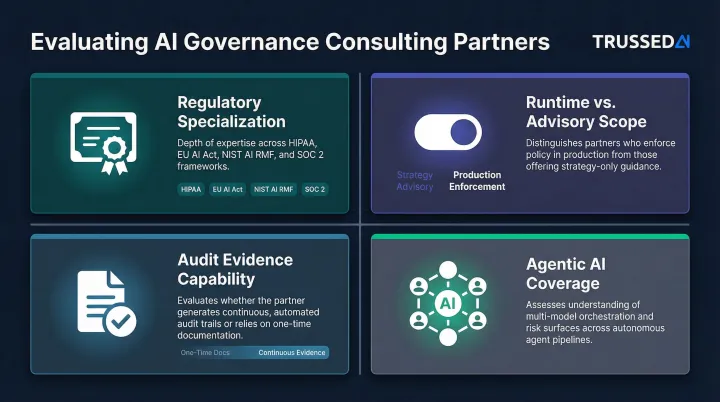
Four Evaluation Criteria for Governance Consulting
Use these four criteria to assess any governance consulting candidate before engaging:
Regulatory Specialization , Ask for documented evidence of HIPAA, EU AI Act, or NIST AI RMF implementations in organizations similar to yours. Generic AI consultants without regulatory depth will struggle to map policies to compliance requirements.
Runtime vs. Advisory Scope - Determine whether consultants deliver strategy only or help implement and enforce governance in production systems. Advisory-only engagements leave enforcement to internal teams; runtime-capable partners implement controls that actively prevent violations.
Audit Evidence Capability - Ask to see examples of audit evidence deliverables. Effective governance partners generate continuous compliance evidence as a byproduct of governed interactions, rather than treating documentation as a separate exercise.
Agentic AI Coverage - Confirm the partner understands multi-model, multi-agent risk surfaces. As enterprises deploy AI agents and automated workflows, governance must address tool calls, data access, workflow triggers, and inter-agent communication,not just model outputs.
Consulting Firm vs. Platform-Native Partner
Traditional consulting firms deliver frameworks, policies, and recommendations,the client is responsible for enforcement. Platform-native governance providers combine consulting advisory with a runtime control plane that enforces policies in production. For enterprises in regulated industries deploying AI at scale, this represents a "strategy + execution" choice, not an either/or.
When evaluating platform-native options, key technical requirements include:
- Real-time policy enforcement across models and agents
- Drop-in integration without application code changes
- Continuous compliance monitoring with automated evidence generation
- Sub-20ms latency to avoid production performance degradation
Trussed AI's control plane is built specifically for this model,governing production AI deployments in regulated industries. The platform enforces policies at runtime across AI apps, agents, and developer tools, turning static policies into real-time control while generating governance evidence as a byproduct of every governed interaction.
Red Flags to Watch For
- Consultants who deliver static PDF frameworks without implementation support
- Firms with no experience in your specific regulatory environment
- Partners who cannot demonstrate how governance controls remain effective as AI systems change post-deployment
- Engagements with no defined mechanism for producing audit evidence (as opposed to just audit readiness advice)
- Consultants who treat agentic AI governance the same as static model governance
Essential Questions to Ask Governance Consulting Candidates
These questions move you from red-flag screening to concrete due diligence:
- What regulatory frameworks have you implemented controls for in our industry?
- How does your framework remain valid as our AI models are updated or new agents are deployed?
- What does your audit evidence deliverable look like, and can we see an example?
- How do you handle governance for agentic AI versus static models?
- What is your process for policy enforcement in production, or is that out of scope?
- Can you provide references from organizations in our industry that have completed similar engagements?
Frequently Asked Questions
What is AI governance consulting and how is it different from general AI consulting?
AI governance consulting focuses on policy frameworks, regulatory compliance, audit trail architecture, and risk classification rather than strategy, use case identification, or model development. It's a compliance-oriented, ongoing discipline requiring specialized regulatory knowledge, not a one-time strategy exercise.
How much does AI governance consulting typically cost?
Readiness assessments cost $15,000–$50,000, framework implementations run $40,000–$150,000+, enterprise programs range from $150,000–$500,000+, and monthly retainers cost $8,000–$25,000. Regulated industries face a 20-40% premium over standard AI consulting rates due to specialized compliance requirements and higher violation stakes.
How do you calculate ROI for AI governance consulting?
Governance ROI is a risk-avoidance calculation: compare probability-weighted regulatory fine exposure plus annual manual compliance costs against the total consulting investment, targeting a payback period of 12–18 months. Both avoided fines and reduced operational compliance costs count toward that figure.
What are the hidden costs organizations typically miss in AI governance engagements?
Three costs consistently catch organizations off guard:
- Policy refresh as AI systems evolve , typically 15–30% of initial costs annually
- Regulatory change management as frameworks like the EU AI Act mature
- Internal implementation time to put governance controls into practice across engineering and compliance teams
What should regulated industries specifically look for in an AI governance consulting partner?
Regulated industries should prioritize regulatory framework expertise (HIPAA, EU AI Act, NIST AI RMF), experience governing agentic AI deployments, and the ability to produce audit-ready evidence, not just policy documents. Verify that partners have delivered similar engagements in your industry with measurable compliance outcomes.
When should an organization choose a governance platform over, or alongside, a consulting firm?
Consulting firms deliver strategy and frameworks; governance platforms enforce controls in production at runtime. Organizations deploying AI at scale in regulated industries typically need both , advisory to design the governance model, and a runtime layer to ensure it's enforced across every AI interaction. One designs the policy; the other ensures it holds.