Introduction
Data centers face unprecedented financial pressure as AI workloads scale faster than budgets or visibility tools can track. GPU clusters expand, LLM API calls multiply, and consumption-based platforms like Databricks and Snowflake accumulate charges by the second - yet accountability structures remain stuck in monthly reconciliation cycles. The result is a growing cost exposure that's difficult to trace and even harder to fix before damage compounds.
"Cost governance" is often dismissed as a finance team's problem. In AI-powered data centers, though, costs shift hourly, resources are shared across tenants and teams, and pricing models layer token-based metering atop per-second GPU billing.
The financial stakes are concrete: 84% of enterprises are watching gross margins erode by 6% or more due to unmanaged AI infrastructure costs, with heavy AI adopters seeing margin hits reach 16%.
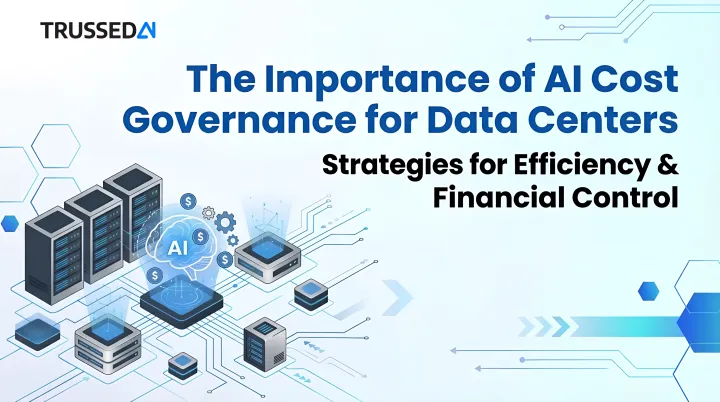
This article explains why AI cost governance has become a core operational discipline for data centers: what it measurably prevents, and what it enables when implemented well.
Key Takeaways
- AI cost governance makes infrastructure spend visible, attributable, and controllable in real time - before budgets overrun and margins erode
- Without it, data centers risk underbilling in multi-tenant GPU environments, unchecked margin erosion, and reactive firefighting when bills arrive
- The highest-impact gains come from real-time cost attribution, proactive anomaly detection, and lower regulatory exposure
- AI workloads behave like utilities, not fixed assets,GPU-as-a-Service, token-based LLM APIs, and consumption platforms require governance to match
- Organizations that embed cost governance from the start scale AI responsibly; those that delay inherit a compounding problem
What Is AI Cost Governance for Data Centers?
AI cost governance is the set of structures, policies, and tooling that ensures AI infrastructure costs are tracked in real time, attributed to the right owners, and tied to measurable business outcomes,not just reconciled at month end.
In a data center context, that spans several cost layers - each with its own pricing model and billing cadence:
- GPU compute billed per second
- LLM API usage priced per token
- Consumption-based platforms like Databricks and Snowflake
- Kubernetes orchestration layers
- Egress and storage
The FinOps Foundation defines "FinOps for AI" as a specialized scope addressing cost complexity and spend unpredictability that transcends traditional technology boundaries.
AI cost governance delivers financial precision, accountability, and scalability. Done right, it's the control layer that determines whether a data center can run AI workloads profitably and at scale - not a compliance checkbox filled in after the fact.
Key Advantages of AI Cost Governance for Data Centers
The advantages below map directly to metrics that data center operators, FinOps teams, and engineering leaders already track: margins, utilization, forecast accuracy, and compliance exposure.
Advantage 1: Real-Time Cost Visibility and Attribution Across AI Workloads
AI workloads are built on a layered, multi-vendor cost ecosystem - GPU compute, model APIs, orchestration, storage, egress - and without a unified view, no single team knows the true cost of any given workload, feature, or customer.
What this unlocks:
By tagging and attributing spend at the model, application, tenant, and team level in real time, operators gain a single source of cost truth across cloud and on-prem resources, replacing manual estimates and fragmented billing data.
Granular attribution enables accurate chargeback in multi-tenant GPU environments, closing the underbilling gap where one tenant's consumption quietly subsidizes another's AI spend. Research shows 84% of respondents cite managing cloud spend as their top challenge, with estimated wasted cloud spend climbing to 29% due to the complexity of AI and PaaS offerings.
Attribution also connects directly to pricing decisions. When operators know the cost-to-serve per customer, per model, or per SKU, they can price AI features accurately rather than guessing , protecting margins directly.
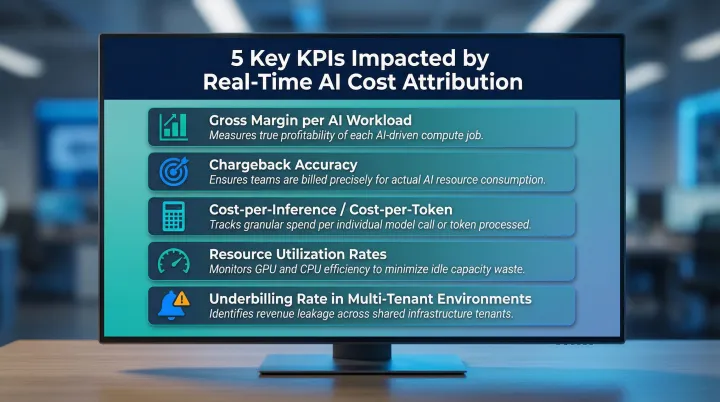
KPIs impacted:
- Gross margin per AI workload
- Chargeback accuracy
- Cost-per-inference or cost-per-token
- Resource utilization rates
- Underbilling rate in multi-tenant environments
When this advantage matters most:
This advantage is most critical at scale , specifically in GPU-as-a-Service environments, multi-tenant data centers, and organizations running multiple AI models or agentic workflows simultaneously where costs spread across workloads quickly.
Advantage 2: Proactive Budgeting and Anomaly Detection , From Reactive to Predictive
The traditional data center billing cycle - monthly reports, quarterly reconciliations - is incompatible with AI workloads, which can spike overnight due to a single misconfigured pipeline, an uncapped inference endpoint, or an unexpected usage surge.
What this unlocks:
By establishing usage baselines and applying real-time anomaly detection, teams can flag cost spikes as they happen - not weeks later - and use historical patterns to forecast demand with accuracy.
Predictive budgeting replaces "bill shock" events with planned, defensible budget cycles. Currently, 80–85% of enterprises miss their AI infrastructure forecasts by more than 25%, driven by a 30% average surge in cloud spending tied to GenAI. In one documented case, a developer testing autonomous agents on AWS Bedrock incurred a $58,000 bill in a single week due to a routing bug.
When engineering and finance share a real-time cost view grounded in usage data, the tension between "the team that spends" and "the team that approves" gives way to shared accountability.
KPIs impacted:
- Forecast accuracy (planned vs. actual spend)
- Mean time to detect cost anomalies
- Budget variance percentage
- Cost overrun frequency
When this advantage matters most:
This advantage has the highest impact during rapid AI experimentation or production scaling , when new models, agents, or workflows are being deployed quickly and usage patterns are not yet stable.
Advantage 3: Reduced Regulatory and Compliance Risk in Governed AI Spend
For data centers serving regulated industries , healthcare, insurance, financial Solution , cost governance is not purely a financial concern. Unaccounted AI spend often signals unaccounted AI usage, creating regulatory exposure alongside budget risk.
What this unlocks:
Continuous audit trails - capturing which teams and applications consumed AI infrastructure, at what cost, and whether that spend aligned with approved policies - are automatically generated as part of normal operational tracking. Compliance evidence stops being a separate documentation effort.
Audit-ready attribution also reduces the manual workload of compliance reviews. Despite 90% of security leaders claiming visibility into their AI footprint, 59% admit to the presence of ungoverned "Shadow AI", violating strict new logging mandates. Shadow AI initiatives frequently surface first as anomalies in cost data, making spend governance an early warning system for policy violations.
KPIs impacted:
- Compliance violation rate
- Audit preparation time
- Regulatory incident frequency
- Percentage of AI spend covered by documented policy
When this advantage matters most:
This advantage is especially high-impact for data centers in or serving regulated industries , insurance, healthcare, financial Solution, and universities , where every AI-driven interaction may carry both cost and compliance implications.
What Happens When AI Cost Governance Is Missing or Ignored
The compounding consequences of ungoverned AI infrastructure spend in a data center context include:
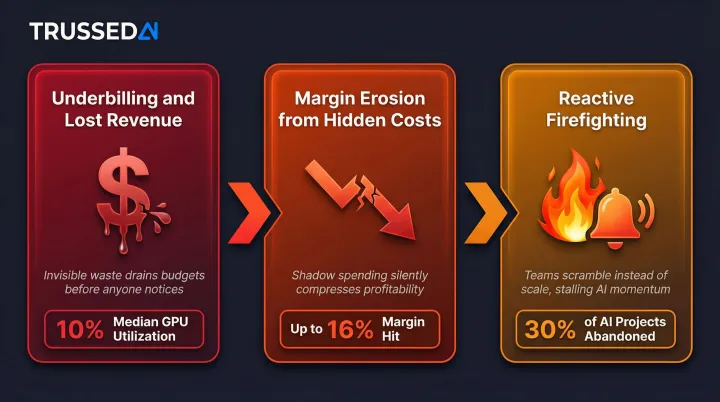
Underbilling and lost revenue in multi-tenant GPU environments: Operators unknowingly subsidize customer AI usage when tracking is too coarse to charge accurately. Median GPU utilization in Google clusters sits at just 10% , default Kubernetes configurations reserve entire cards even when workloads need a fraction of that capacity.
Margin erosion from missing cost-to-serve clarity: What looks like a profitable AI offering often becomes a loss center once full infrastructure costs are attributed. For companies with heavy AI adoption, margin hits reach 16%, translating to millions in lost EBITDA.
Reactive firefighting instead of forward progress: Engineering and finance teams spend cycles chasing surprise bills and correcting misallocated costs rather than building. Gartner predicts 30% of generative AI projects will be abandoned after the proof-of-concept phase by end of 2025 , escalating costs and weak financial governance are the primary drivers.
The scaling problem: without governance structures in place from the start, cost complexity grows faster than the team's ability to manage it. A single untracked workload is a nuisance. Dozens of them, each growing independently, create the kind of financial exposure that surfaces in quarterly earnings calls , not sprint retrospectives.
How to Get the Most Value from AI Cost Governance
AI cost governance delivers the most value when it is embedded at the infrastructure layer,not bolted on after deployment. This means tagging workloads from day one, establishing cost attribution policies before workloads scale, and aligning engineering, finance, and operations teams around a shared cost language.
Governance compounds in value under three operating conditions:
- Applied consistently across all AI environments , not just cloud, but on-prem and hybrid
- Cost insights are acted upon , through forecasting and rightsizing rather than just documented
- Anomaly detection triggers action, not just alerts
Purpose-built tooling makes the difference between governance that informs and governance that controls. Trussed AI's unified control plane enforces cost attribution policies in real time across models, agents, applications, and developer environments. For data center operators, that means full visibility into AI spend with less than 1% compliance violations and a 50% reduction in manual governance workload,without slowing down teams.
Conclusion
AI cost governance is an operational control layer , not a finance team add-on , that determines whether a data center can run AI workloads profitably and at scale.
The advantages compound over time: real-time visibility enables accurate pricing, accurate pricing protects margins, and audit-ready cost attribution reduces compliance risk. Each benefit reinforces the next when governance is applied consistently from the start.
Organizations that treat cost governance as infrastructure , embedded from day one and reviewed regularly , are the ones that scale AI without losing control of the economics behind it.
Frequently Asked Questions
What is AI cost governance for data centers?
AI cost governance is the practice of making AI infrastructure spend continuously visible, attributable, and controllable in real time. It covers GPU compute, model APIs, orchestration, storage, and egress , giving data center operators the tools to manage costs proactively rather than reactively.
What is the 30% rule in AI?
The "30% rule" commonly refers to the finding that AI and generative AI adoption has driven approximately 30% surges in cloud spending at many enterprises. It highlights how rapidly AI workloads inflate infrastructure costs when left ungoverned, making cost controls an operational priority, not an afterthought.
How to reduce the cost of AI?
Several levers make a measurable difference:
- Granular cost attribution to identify waste by team, model, and application
- Anomaly detection to catch runaway spend before it compounds
- Rightsizing and deprovisioning idle inference endpoints
- Separating R&D training budgets from production inference costs
- Commitment-based pricing for stable, predictable workloads
What are the biggest hidden costs in running AI workloads in a data center?
The most overlooked cost drivers include idle inference endpoints, over-provisioned storage, data egress fees, orchestration layer overhead, and the cost of retraining cycles. None of these appear when teams track only GPU hours, which is why broader attribution coverage matters.
How does AI cost governance differ from traditional FinOps for data centers?
Traditional FinOps was designed for relatively stable cloud infrastructure. AI cost governance must account for second-level GPU billing, token-based API pricing, multi-tenant resource sharing, and workloads that spike unpredictably , all of which demand real-time visibility rather than monthly reporting cycles.
When should an organization start implementing AI cost governance?
Day one - tagging workloads, establishing attribution policies, and setting anomaly detection thresholds before workloads scale is far less costly than retrofitting governance after costs and attribution gaps have already multiplied.