Introduction
Sustainability teams in 2026 are managing hundreds of ESG data points across overlapping frameworks, with tightening deadlines and rising investor scrutiny. The EU's Corporate Sustainability Reporting Directive (CSRD) now covers thousands of companies, ISSB standards have gained mandatory traction in 21 jurisdictions, and regulatory pressure on ESG claims has intensified—even as the US SEC stepped back from its climate disclosure rule in March 2025.
What once took weeks of manual analysis—framework gap assessments, peer benchmarking, disclosure drafting—now runs in hours. AI platforms purpose-built for ESG deliver automated framework mapping, NLP-driven document analysis, and audit-ready outputs at a scale no sustainability team could match manually.
The core challenge isn't just automating reporting. It's ensuring that AI-generated ESG outputs are defensible, auditable, and compliant at scale. As AI systems take on more responsibility for regulated disclosures, the governance of those systems becomes a compliance question in its own right.
TLDR
- AI has become essential infrastructure for ESG analysis, compressing framework gap analyses and peer benchmarking from weeks to hours
- Leading platforms deliver automated framework mapping, NLP document analysis, peer benchmarking, and audit-ready outputs beyond basic data collection
- IBM Envizi, Persefoni, Salesforce Net Zero Cloud, and peers each target distinct enterprise use cases and maturity levels
- ESG platforms handle data and reporting — AI governance infrastructure (policy enforcement, audit trails, security controls) is a separate layer that regulated industries must evaluate before full deployment
Why AI Is Transforming ESG Analysis in 2026
AI for ESG analysis in 2026 means platforms using NLP, machine learning, and generative AI to process unstructured disclosures, automate framework mapping, surface data anomalies, and generate peer comparisons at scale. This goes well beyond what traditional reporting software can do. The ESG reporting software market reflects this shift, projected to grow from $1.3 billion in 2026 to $2.9 billion by 2031 at 17.4% CAGR. Organizations are abandoning manual spreadsheets for AI-driven platforms that produce audit-ready data integrated with financial and operational systems.
Three regulatory shifts are converging in 2026 to make platform selection consequential:
- CSRD enforcement is expanding to large non-NFRD companies for FY2025 reporting, with listed SMEs following for FY2026
- ISSB standards have reached mandatory adoption across 21 jurisdictions as of January 2026
- The EU AI Act entered full applicability in August 2026, adding a compliance layer on top of the AI tools themselves
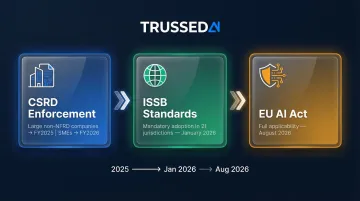
That last point matters more than most organizations realize. The platform you use to analyze ESG data is now itself subject to regulatory scrutiny — making ESG AI platform selection a decision with real legal and operational weight.