Introduction
Federal AI regulations more than doubled - from 25 in 2023 to 59 in 2024 - while global legislative mentions of AI rose 21.3% across 75 countries in the same year. Enterprises are deploying dozens of AI models per month, but the regulatory frameworks governing them are moving just as fast.
The EU AI Act, U.S. state-level AI laws, and sector-specific guidance from healthcare and financial regulators don't wait for quarterly compliance reviews.
Manual tracking can no longer keep pace. Organizations deploying AI without real-time compliance awareness aren't just risking fines - they're creating operational exposure. This article covers how real-time AI compliance alert systems work, what they monitor, and how they transform governance from a periodic exercise into a continuous, enforceable process.
Key Takeaways
- AI regulations multiply across federal, state, and international jurisdictions at a pace manual tracking cannot match
- Manual compliance monitoring leaves dangerous gaps between a regulatory change and your team's response
- Automated alert systems scan regulatory sources continuously and surface only what's relevant to your AI stack
- Effective systems connect alerts to workflows and enable runtime enforcement of updated policies
- Regulated enterprises that automate compliance monitoring cut governance workload by up to 50% and keep violation rates below 1%
The AI Regulatory Landscape: What Enterprises Need to Monitor
The scope of AI regulation is expanding across multiple dimensions simultaneously. The EU AI Act entered force on August 1, 2024, with staged enforcement milestones: prohibitions on unacceptable-risk systems took effect February 2, 2025; General Purpose AI governance rules apply from August 2, 2025; and full application begins August 2, 2026.
Stateside, the pace is just as relentless. In 2023, fewer than 200 AI-related bills were introduced across state legislatures. By 2024, lawmakers in 45 states had introduced 635 AI-related bills , 99 of which were enacted into law.
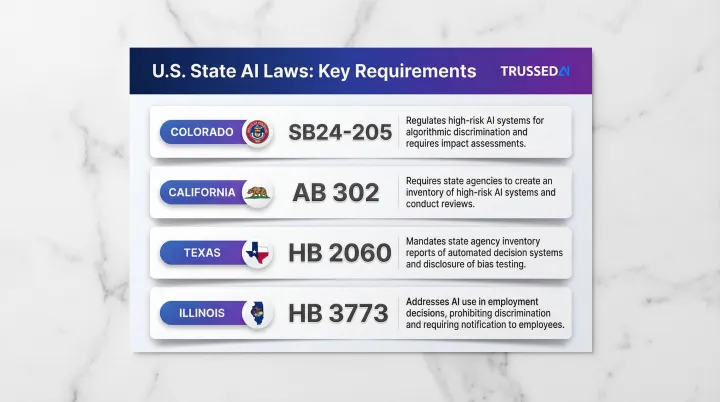
Key State AI Laws:
- Colorado SB24-205: Requires deployers of high-risk AI systems to use reasonable care to protect consumers from algorithmic discrimination, provide disclosures, and conduct impact assessments
- California AB 302: Mandates state agencies to conduct comprehensive inventories of all high-risk automated decision systems
- Texas HB 2060: Requires state agencies to submit inventory reports describing data inputs, known biases, and whether systems make final decisions without human intervention
- Illinois HB 3773: Prohibits employers from using AI that subjects employees to discrimination and requires notification when AI is used for employment decisions
Sector-Specific Federal Guidance
Federal agencies are actively extending existing regulatory frameworks to cover AI deployments , often without creating new rules, simply reinterpreting existing ones:
Healthcare
- FDA's Predetermined Change Control Plan guidance (December 2024) requires validation methodology and impact assessments for AI-enabled device modifications
- HHS OCR's Section 1557 Final Rule prohibits discrimination via patient care decision support tools, requiring covered entities to identify and mitigate risks by May 1, 2025
- HIPAA Security Rule NPRM explicitly states that ePHI in AI training data and prediction models is protected by HIPAA
Financial Services
- CFPB Circular 2023-03 requires creditors to provide specific, accurate reasons for adverse actions, explicitly stating there is "no special exemption for artificial intelligence"
- Automated Valuation Models Final Rule requires institutions using AVMs for credit decisions to adopt quality control standards ensuring confidence in estimates and nondiscrimination compliance
- OCC guidance classifies AI tools as models, meaning they must comply with existing Model Risk Management requirements
The Dual Compliance Surface
Organizations using AI face a compounded challenge. Unlike general compliance, AI-deploying enterprises must track not only regulations governing their industry but also regulations governing the AI tools themselves,model transparency requirements, bias testing mandates, incident reporting obligations. Keeping pace with both layers simultaneously , across jurisdictions, sectors, and enforcement timelines , is where manual tracking breaks down and real-time monitoring becomes a practical necessity.
Why Manual Compliance Tracking Is Breaking Down
Manual compliance methods - spreadsheets, newsletter subscriptions, scheduled legal reviews - are fundamentally reactive. They create compliance lag: the gap between when a regulation changes and when an enterprise team knows about it, interprets it, and adapts their AI systems. This lag is where violations occur.
The Alert Fatigue Crisis
Many organizations have some form of monitoring but are buried in generic, unfiltered regulatory updates. Enterprise security and compliance teams receive an average of 4,330 alerts daily, leaving 63% completely uninvestigated. In Anti-Money Laundering contexts, false positive rates typically range between 85% and 95%, meaning the vast majority of alerts don't represent genuine risk.
When every update triggers a notification, teams learn to ignore them. Alert fatigue doesn't just slow response. It causes teams to miss the critical changes that genuinely require action.
Resource Constraints and Rising Workloads
Compliance teams in regulated industries are stretched thin , and the workload is accelerating. Key benchmarks tell the story:
- 85% of executives say compliance requirements have grown more complex in three years (2025 PwC survey)
- 32% increase in average SOX program hours over two years, reaching 15,580 hours in FY24 (2025 KPMG SOX Survey)
- 42% of compliance teams spend 1–3 hours per week manually tracking regulatory developments
- 40% of Global Systemically Important Banks dedicate 8–10 hours per week to the same task
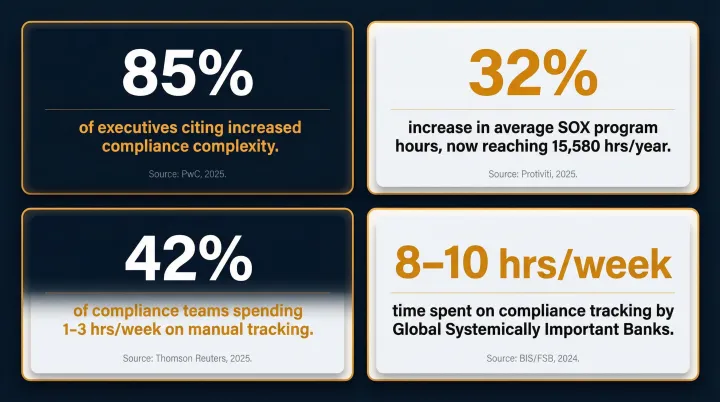
Those hours spent on manual tracking are hours not spent on strategic governance , a tradeoff that grows more costly as AI regulatory volume increases.
Multi-Jurisdictional Coordination Failure
For enterprises operating across states or internationally, manual tracking requires separate processes per jurisdiction with no shared context. When California updates its AI disclosure rules while the EU AI Act adds a new technical standard in the same quarter, manual processes create blind spots. Coordination failures worsen when different teams track different jurisdictions without a unified view.
The Auditability Gap
Manual compliance tracking rarely produces clean, timestamped evidence trails. When auditors ask for proof of when an organization became aware of a regulatory change and what it did in response, manual systems cannot answer that question reliably. This evidentiary gap becomes a liability during regulatory examinations.
How Real-Time AI Compliance Alert Systems Work
Real-time AI compliance monitoring systems replace periodic manual checks with continuous surveillance, using natural language processing and machine learning to filter noise and surface actionable intelligence.
Continuous Automated Scanning
These systems automatically scan primary regulatory sources,government websites, federal registers, legislative databases, regulatory agency announcements,across all relevant jurisdictions 24/7. Instead of waiting for quarterly legal reviews or monthly newsletter summaries, organizations receive updates as soon as regulatory changes are published.
The NLP and ML Layer
Natural language processing enables these systems to interpret dense legal text at scale, converting regulatory documents into structured requirements, deadlines, and obligations. Machine learning classifiers trained on large volumes of regulatory documents then identify which changes actually matter,based on a specific organization's AI footprint, industry, and operating geography.
Key NLP Capabilities:
- Extracts enforceable obligations by scanning for trigger phrases like "shall" and "must" - only ~35% of regulatory text contains actual requirements; the rest is filtered out
- Maps extracted obligations directly to internal control frameworks and product lines using knowledge graphs and semantic analysis
- Scores and prioritizes signals by risk level, suppressing low-impact noise while escalating anomalies that warrant immediate action
The results at scale are measurable. Eigen Technologies automated extraction of over 50 data points from Qualified Financial Contracts for Goldman Sachs, processing 1,500 documents straight-through per day to meet Dodd-Frank requirements , a task previously requiring significant manual review cycles.
That kind of throughput illustrates why alert quality matters as much as detection speed.
What a Useful Alert Contains
Contrast a low-quality alert ("Policy violation detected") with a high-quality, actionable one that answers:
- What changed? The specific regulatory requirement or obligation introduced
- Which of our AI systems does this affect? The models, applications, or workflows impacted
- What is required, and by when? The action needed and compliance deadline
- What is the consequence of inaction? The regulatory, financial, or operational risk
Alert quality, not alert volume, determines whether compliance teams respond effectively.
Intelligent Relevance Filtering
Well-designed systems build an organizational context profile,AI systems in use, industries served, jurisdictions of operation,and use this to prioritize alerts. Compliance teams only see changes that directly affect their stack. The result is a feed that surfaces what requires action, rather than burying teams in changes they can safely ignore.
Automated Documentation and Audit Trail Generation
Modern systems automatically log when a regulatory change was detected, when it was flagged, who was notified, and what action was taken. This creates a timestamped compliance record as a byproduct of the monitoring process itself, eliminating the need for manual documentation reconstruction during audits.
From Alert to Action: Turning Compliance Intelligence into Runtime Enforcement
Receiving an alert is not compliance. The critical missing step in most alert-only systems is the connection between knowing a regulation changed and actually enforcing updated policy across active AI systems.
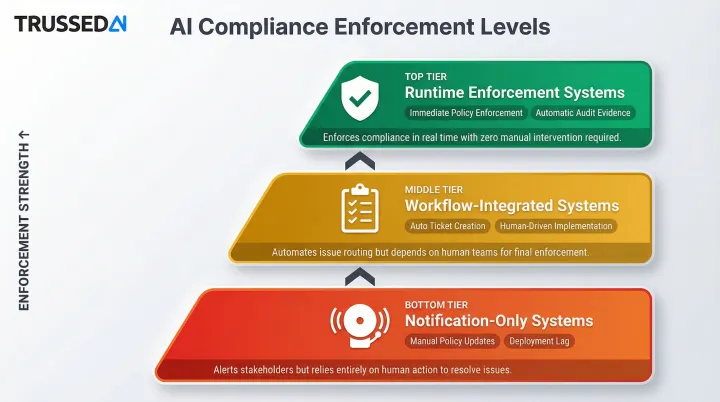
The Notification-to-Enforcement Spectrum
Notification-only systems (weakest): Alert compliance teams but require manual policy updates, code changes, and deployment cycles before enforcement occurs.
Workflow-integrated systems (moderate): Automatically create tickets, assign tasks, and track remediation but still require human-driven implementation.
Runtime enforcement systems (strongest): Translate compliance requirements directly into enforceable policies that govern AI interactions immediately, with audit evidence generated automatically.
How Alerts Should Trigger Workflow Updates
Effective systems integrate with enterprise AI governance infrastructure to automatically translate new compliance requirements into updated policies, guardrails, or operational constraints. For example:
- A new disclosure requirement triggers an update to model output templates
- A new data handling rule triggers updated routing logic
- A bias testing mandate triggers automated evaluation workflows before model deployment
Trussed AI's Runtime Enforcement Approach
Trussed AI's control plane enforces governance at runtime by sitting as a proxy in the flow of AI interactions. When a compliance alert surfaces a new policy requirement, it's pushed directly into the enforcement layer that governs every AI interaction across apps, agents, and developer tools in near real time.
The platform intercepts every request before it reaches models, evaluating policies at the point of execution. When a policy update is introduced, it's configured through the Trussed controller and immediately becomes active across the entire governance infrastructure, with no application code changes required.
For agentic systems, governance becomes particularly granular. Every tool call, API request, data access, and workflow trigger is authorized against policy before it executes. This execution-layer enforcement ensures compliance boundaries are applied where actions actually occur, not just at the output stage.
That same enforcement layer generates continuous audit evidence automatically. Each governed interaction is logged with:
- Policy evaluation results
- Model version and timestamp
- Data lineage
This creates an immediate audit trail showing that new compliance requirements were enforced from the moment they were activated.
The Human Oversight Balance
Not all policy updates should be fully automated. The practical spectrum includes:
- Threshold adjustments, guardrail refinements, and routine policy updates - applied automatically without human review
- Model decommissioning decisions, major policy overhauls, and changes to critical workflows - these require human sign-off before activation
The goal is controlled, documented intervention,not unchecked automation. Effective systems can pre-stage high-stakes changes with AI-generated remediation recommendations, enabling informed human decisions without sacrificing speed.
Integrating Compliance Alerts into Enterprise AI Workflows
Real-time alert systems multiply their value when they connect to existing enterprise infrastructure rather than operating as standalone notification tools.
Integration Architecture
Modern alert systems connect to enterprise infrastructure via APIs, feeding updates into GRC platforms, ticketing systems, SIEM tools, and AI governance platforms. When an alert can automatically trigger an action or assign a task rather than sitting in an inbox, response times drop from days to hours.
Common Integration Points:
- GRC platforms: Automatically create compliance tasks and track remediation status
- Ticketing systems: Generate tickets for specific teams with context and priority
- SIEM tools: Correlate compliance events with security incidents
- AI governance platforms: Push policy updates directly into enforcement layers
For example, Trussed AI connects to this infrastructure as a proxy layer through public APIs, with SDKs for Python, TypeScript, Go, and REST , letting different teams plug in at their preferred level of abstraction without changing existing application code.
Role-Based Alert Routing
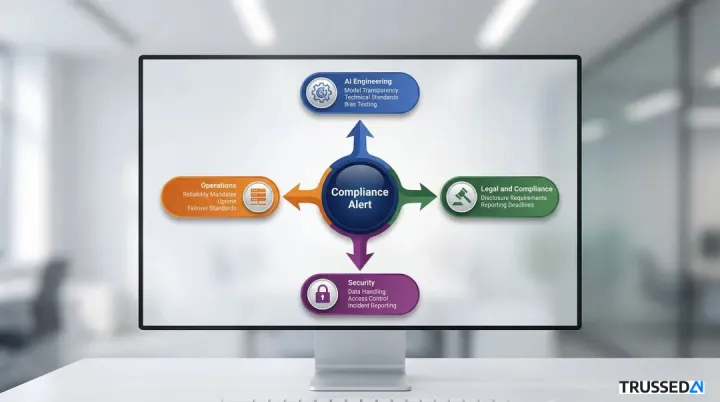
Different regulatory changes affect different teams. A new model transparency requirement is relevant to the AI engineering team, while a data retention mandate affects legal and security. Effective systems route alerts to the right stakeholders with context relevant to their role, reducing coordination overhead.
Example Routing Logic:
- AI engineering receives model transparency requirements, technical standards updates, and bias testing mandates
- Legal and compliance gets disclosure requirements, contractual obligations, and reporting deadlines
- Security handles data handling rules, access control requirements, and incident reporting obligations
- Operations covers system reliability mandates, uptime requirements, and failover standards
The Feedback Loop
Well-implemented systems improve over time. When compliance teams mark alerts as relevant or irrelevant, the system refines its filtering , narrowing signal from noise with each cycle. Over weeks of use, teams typically find they spend less time triaging alerts and more time acting on them.
The Business Case for Real-Time AI Compliance Monitoring
Regulators are moving faster than most compliance teams. For enterprises deploying AI at scale, that gap has a price , measured in fines, audit failures, and eroded customer trust.
The Cost of Inaction
Regulators are not waiting for consumer harm to occur; they're proactively auditing AI deployments. In September 2024, the FTC announced "Operation AI Comply," a law enforcement sweep resulting in five actions against companies using AI to supercharge deceptive or unfair conduct. The SEC's 2025 Examination Priorities explicitly state that the Division will assess whether firms have implemented adequate policies to monitor their use of AI.
The financial consequences are steep. In March 2024, the SEC fined two investment advisers $400,000 for "AI washing", citing false and misleading statements about their purported use of artificial intelligence. The CFPB explicitly banned the use of vague checklist reasons for AI-driven credit denials, stating there is "no special exemption for artificial intelligence."
The broader numbers sharpen the picture: the global average cost of a data breach is $4.44 million, and non-compliance costs have increased 45% since 2011. A single material violation can dwarf an entire year of compliance platform spend.
Operational and Strategic ROI
Beyond penalty avoidance, real-time monitoring produces measurable efficiency gains. Gartner projects that effective AI governance technologies can reduce regulatory expenses by 20%, offsetting the 32% increase in average SOX compliance hours reported by KPMG.
Organizations deploying AI governance platforms are 3.4 times more likely to achieve high effectiveness in AI governance than those that do not. At the operational level, organizations implementing AI-driven governance platforms save 20 hours per month per employee through automated workflows.
For AI vendors serving regulated industries, proactive compliance also functions as a sales asset. Enterprise customers in financial Solution, healthcare, and insurance increasingly require audit-ready evidence before signing , making continuous monitoring a prerequisite, not a differentiator.
Market Growth and Adoption
The demand for automated compliance solutions is driving substantial market growth:
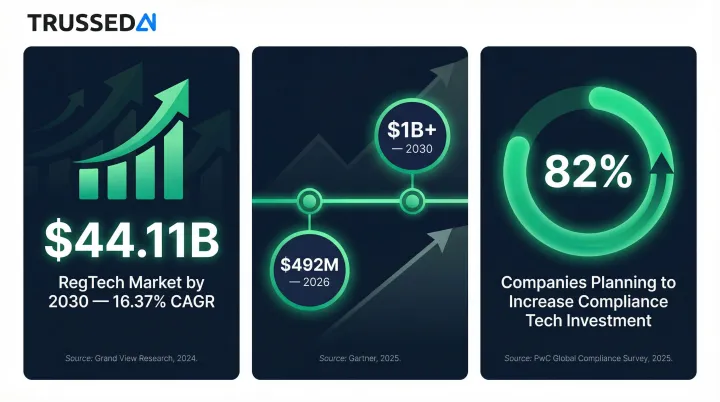
- The global RegTech market is projected to reach $44.11 billion by 2030, advancing at a 16.37% CAGR
- Gartner projects AI governance platform spending will hit $492 million in 2026 and surpass $1 billion by 2030
- A 2025 PwC survey found 82% of companies plan to invest more in compliance technology
Manual compliance processes can't keep pace with how fast regulations are changing. That reality is pushing enterprise investment toward platforms that monitor, alert, and enforce continuously , without adding headcount.
Frequently Asked Questions
What types of AI regulations should enterprises be monitoring in real time?
Enterprises should monitor EU AI Act enforcement timelines, U.S. federal and state-level AI laws (disclosure requirements, algorithmic accountability, automated decision systems), and sector-specific AI guidance in healthcare (FDA, HIPAA), finance (SEC, CFPB), and insurance. Multi-jurisdictional coverage is essential for any enterprise with broad operations.
How is real-time AI compliance monitoring different from traditional regulatory tracking tools?
Traditional tools are periodic and passive - newsletters, manual reviews, scheduled legal checks. Real-time AI monitoring is continuous, context-aware, and automated, using NLP and ML to filter relevant changes and surface alerts that teams can act on immediately - not raw document volumes that still require manual review.
What should happen after a real-time compliance alert is triggered?
The alert is routed to relevant stakeholders, assessed for urgency and applicability, and mapped to affected AI systems or workflows. It then triggers a policy update or remediation task, with every step documented for audit purposes.
How do real-time alerts support audit readiness?
Automated systems create timestamped records of when regulatory changes were detected, who was notified, and what actions were taken. This produces an always-current audit trail without manual documentation effort,so organizations can demonstrate compliance on demand rather than reconstructing evidence after the fact.
Can one system cover compliance requirements across multiple jurisdictions simultaneously?
Yes. Modern AI compliance monitoring platforms scan federal, state, and international regulatory bodies simultaneously, filtering by the jurisdictions relevant to the organization's operations. A single unified system eliminates the coordination gaps that arise when separate regional tracking processes run in parallel.
How long does it take to implement a real-time AI compliance alert system?
Implementation timelines vary by complexity of integration, but platforms with API-based connectivity and pre-built connectors to common GRC and AI governance tools can typically be operational within weeks. Solutions with drop-in integration architectures,like Trussed AI's proxy-based approach,enable deployment without requiring changes to existing application code, cutting deployment timelines further.